
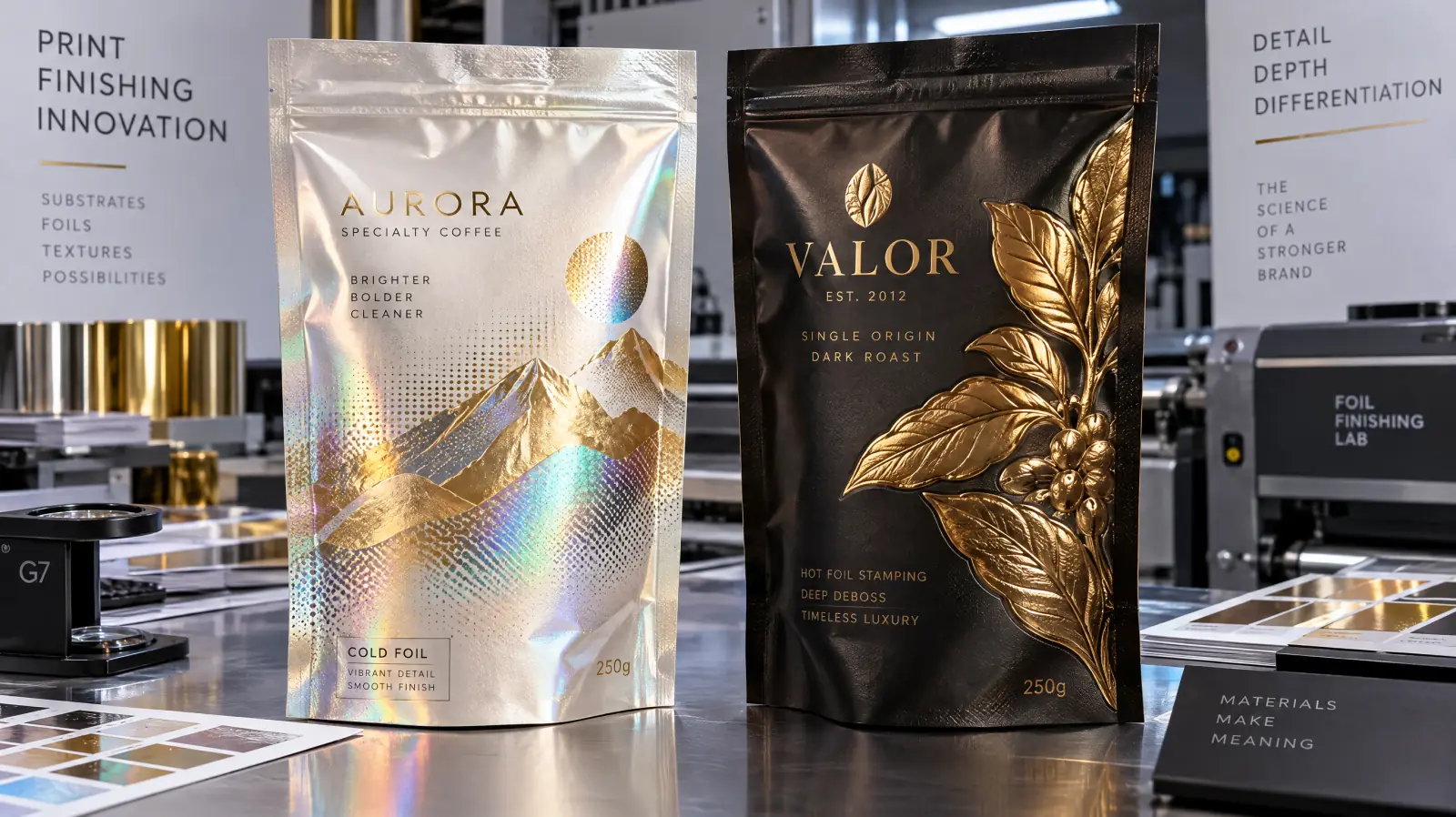
Cold Foil vs Hot Stamping: Flexible Packaging Guide
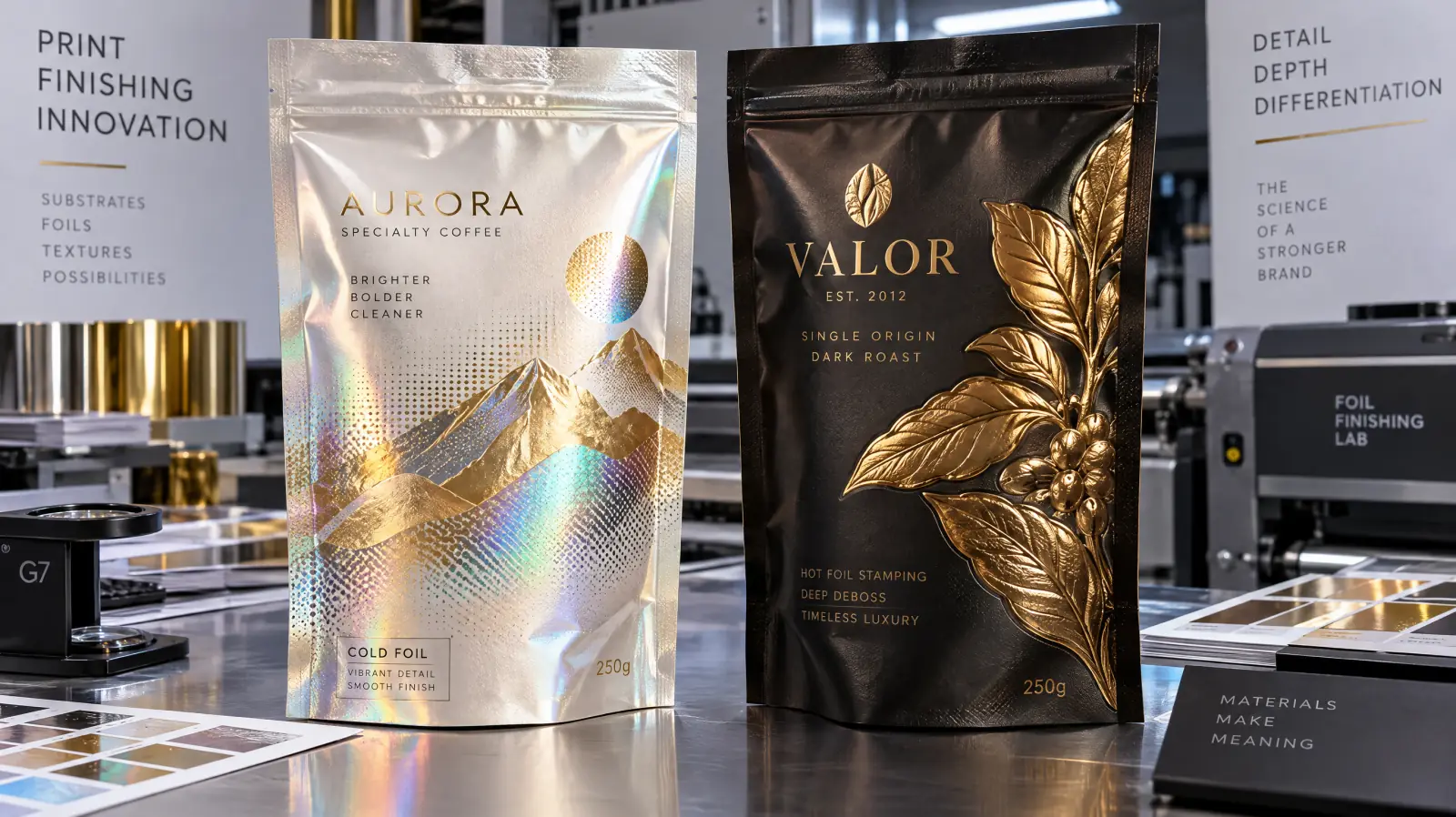
In premium retail and consumer packaged goods (CPG), metallic embellishments are proven drivers of brand value. Eye-tracking and consumer perception studies confirm that reflective metallic accents capture shopper attention up to 2.5 times faster on retail shelves compared to standard CMYK process inks.
However, packaging engineers and brand designers frequently face a technical fork in the road when specifying metallic effects on flexible barrier films and paper carriers: should you choose inline cold foil transfer or traditional heated-die hot foil stamping?
While hot stamping has historically been the gold standard for deep tactile debossing on luxury custom printed gift bags, applying heat and pressure to delicate, extensible flexible barrier films (such as 12µm PET, BOPP, or mono-PE) risks thermal shrinkage, puckering, and barrier pinholing. In response, modern converting presses deploy inline rotary cold foil technology.
This technical engineering guide compares cold foil and hot stamping across mechanical processes, substrate heat thresholds, halftone resolution, tooling economics, and production speeds.
1. Quick Comparison: Cold Foil vs. Hot Stamping
| Production & Aesthetic Metric | Inline Rotary Cold Foil | Heated-Die Hot Foil Stamping |
|---|---|---|
| Transfer Mechanism | UV-curable adhesive + nip pressure + UV light | Heated brass/magnesium die (110°C–160°C) + pressure |
| Tooling Requirements | Standard photopolymer plate or gravure cylinder | Precision CNC-engraved brass or magnesium dies |
| Tooling Cost per Design | Low ($150 – $300 per plate) | High ($600 – $1,800+ per custom metal die) |
| Production Speed | High speed (150 – 250 m/min inline) | Moderate to slow (30 – 70 m/min offline/step-and-repeat) |
| Fine Halftone & Gradients | Exceptional (133–175 lpi screen screens, vignettes) | Limited; best for solid vectors, typography, and line art |
| Tactile 3D Embossing Depth | Completely flat (zero debossing effect) | Deep tactile 3D relief / debossed impressions |
| Thermal Substrate Stress | Zero thermal distortion (ambient process) | High thermal stress; risks shrinking thin polymer films |
| CMYK Overprintability | 100% overprintable inline (infinite metallic hues) | Foil must be printed last; difficult to overprint |
| Optimal Product Formats | Stand-up barrier pouches, flat bottom bags, mailers | Luxury Eurotote paper bags, rigid gift boxes, folding cartons |
Explore our pouch formats in the Stand-Up Pouches Category and Gift Bags Category.
2. Process Mechanics: How Both Technologies Work
Understanding the chemical and mechanical transfer mechanisms explains why each process behaves differently across polymer films and paperboards:
┌────────────────────────────────────────────────────────────────────────┐
│                   METALLIC FOIL PROCESS COMPARISON                     │
├────────────────────────────────────┬───────────────────────────────────┤
│        ROTARY COLD FOIL            │         HOT DIE STAMPING          │
├────────────────────────────────────┼───────────────────────────────────┤
│                                    │                                   │
│   1. Print UV Adhesive             │   1. Heat Metal Die (130°C)       │
│      via standard printing plate   │   2. Align Polyester Foil Carrier │
│   2. Laminate Foil Web onto wet UV │   3. Hydraulic Stamp Downward     │
│   3. UV Lamp Cures Adhesive        │   4. Heat Melts Wax Release Layer │
│   4. Strip Carrier: Foil remains   │   5. Thermal Adhesive Fuses Foil  │
│      only where adhesive was cured │      to Substrate                 │
│                                    │                                   │
│   • Ambient temperature            │   • Thermal + Physical Pressure   │
│   • Ultra-thin 0.2mm line details  │   • Deep tactile impression       │
│                                    │                                   │
└────────────────────────────────────┴───────────────────────────────────┘
The Cold Foil Transfer Cycle
- Adhesive Laydown: A dedicated print station on a flexographic or rotogravure press deposits an ultra-thin layer of specialized UV-curable or cationic adhesive matching the exact vector artwork.
- Nip Roll Lamination: The substrate web and the metallic foil web pass through a high-pressure rubber nip roller, pressing the aluminized side of the foil directly against the wet adhesive.
- Instant UV Photopolymerization: High-intensity UV or LED lamps irradiate the sandwich through the clear polyester carrier, curing the adhesive in milliseconds.
- Stripping Web: The spent carrier film is rewound. Aluminum flakes adhere permanently to the cured adhesive, creating razor-sharp metallic typography, intricate filigree, and soft gradient fades.
The Hot Stamping Cycle
- Tooling Pre-Heat: A CNC-milled brass die is heated to 120°C to 160°C on a platen or rotary stamping press.
- Thermal Activation: As the die strikes the foil web against the substrate, heat melts a micro-thin wax release layer while activating a dry heat-seal adhesive on the foil’s back side.
- Substrate Indentation: The physical force compresses paperboard fibers beneath the die, embossing the metallic foil below the paper surface plane.
3. Substrate Engineering: Thermal Distortion on Flexible Films
The defining reason why flexible packaging converters favor cold foil is thermal dimensional stability:
HOT FOIL ON THIN POLYMER FILM (Puckering Hazard)
┌──────────────────────────────────────────────┐
│  Heated metal die (140°C) contacts 12µm PET   │
│  Polymer web shrinks locally under heat       │
│  Adjacent cool film creates tension wrinkles  │
│  RESULT: BAGGING, PUCKERING & DELAMINATION    │
└──────────────────────────────────────────────┘

COLD FOIL ON THIN POLYMER FILM (Zero Heat)
┌──────────────────────────────────────────────┐
│  Cold UV adhesive transfers foil at 25°C      │
│  Polymer web maintains 100% tension flatness │
│  Barrier layers (AL / EVOH) remain intact    │
│  RESULT: FLAWLESS MIRROR METALLIC SHEEN       │
└──────────────────────────────────────────────┘- Polymer Heat Sensitivity: Biaxially-oriented polypropylene (BOPP) and low-density polyethylene (LDPE) experience molecular relaxation and thermal shrinkage at temperatures above 85°C to 105°C. Hot stamping these films causes unsightly heat-wrinkling (“crow’s feet”) around metallic borders and can degrade the barrier properties of underlying EVOH or foil layers.
- The Cold Foil Advantage: Because the cold foil process operates at ambient room temperature, it exerts zero thermal stress on the flexible web, enabling mirror-smooth metallics on thin 12µm PET, 20µm BOPP, and recyclable MDO-PE mono-material films.
4. The Superpower of Cold Foil: CMYK Overprinting
One of cold foil’s greatest commercial advantages is its ability to be positioned at the beginning of the print press line:
┌────────────────────────────────────────────────────────────────────────┐
│                   INLINE OVERPRINTING ARCHITECTURE                     │
├────────────────────────────────────────────────────────────────────────┤
│                                                                        │
│   Station 1: Laydown UV Adhesive                                       │
│   Station 2: Apply & Cure Silver Cold Foil                             │
│   Station 3: Print Cyan Process Ink                                    │
│   Station 4: Print Magenta Process Ink                                 │
│   Station 5: Print Yellow Process Ink                                  │
│   Station 6: Print Black Process Ink                                   │
│                                                                        │
│   RESULT: A single silver foil roll yields an infinite palette of      │
│   metallic colors:                                                     │
│   • Yellow overprint    ──> Shimmering 24K Gold                        │
│   • Magenta + Yellow    ──> Rich Metallic Rose Copper                  │
│   • Cyan + Magenta      ──> Iridescent Metallic Violet                 │
│   • Cyan overprint      ──> Brilliant Metallic Emerald & Aqua          │
│                                                                        │
└────────────────────────────────────────────────────────────────────────┘
In hot stamping, because the foil is applied via heat and pressure, it is virtually impossible to run the stamped web through subsequent liquid ink stations without scratching the foil. With cold foil, brands achieve complex multi-color metallic effects using only a single standard silver foil roll, dramatically reducing raw material inventory costs.
5. Tooling Economics & Break-Even Analysis
Understanding the tooling and run-speed economics allows procurement teams to select the most cost-effective method across different production volumes:
| Production Quantity | Cold Foil Total Cost (Tooling + Run) | Cold Foil Effective Unit Cost | Hot Stamping Total Cost (Die + Run) | Hot Stamping Effective Unit Cost |
|---|---|---|---|---|
| 1,000 bags | $550 ($250 plate + $300 run) | $0.55 | $1,450 ($1,100 brass die + $350 run) | $1.45 |
| 5,000 bags | $1,150 ($250 plate + $900 run) | $0.23 | $2,100 ($1,100 die + $1,000 run) | $0.42 |
| 10,000 bags | $1,850 ($250 plate + $1,600 run) | $0.185 | $3,100 ($1,100 die + $2,000 run) | $0.31 |
| 50,000 bags | $6,250 ($250 plate + $6,000 run) | $0.125 | $9,600 ($1,100 die + $8,500 run) | $0.192 |
- Low-Volume Advantage: Even at short runs (1,000 to 5,000 units), cold foil eliminates $800+ in metal die engraving charges.
- High-Volume Scaling: At 50,000 units and above, cold foil’s high press speed (200 m/min inline vs 50 m/min offline) delivers a 35% to 45% reduction in total embellishment cost.
6. When to Choose Hot Stamping Over Cold Foil
Despite cold foil’s dominance on flexible polymer films, hot stamping remains the superior choice in specific packaging formats:
- Heavy Paper Carriers & Gift Boxes: On 230–300 GSM coated art paper and rigid cardboard boxes, hot stamping presses down into paper fibers, producing an unmatched tactile 3D debossed texture that shoppers can physically feel with their fingertips.
- Rough Textured & Kraft Papers: Cold foil relies on a micro-smooth adhesive layer. On rough, uncoated natural kraft paper, adhesive sinks into cellulose pores, resulting in dull, mottled foil transfer. Hot stamping uses heat and pressure to iron paper fibers flat, creating sharp, solid metallic borders on rustic kraft stocks.
- True Opaque Metallic Coverage: On thick paper stocks, hot foil offers a slightly higher optical density (100% solid mirror reflectivity) compared to the microscopic adhesive laydown of cold foil.
7. Packaging Engineer Decision Matrix
                          EMBELLISHMENT DECISION TREE
                                       │
                      What is your packaging substrate?
                                       │
                    ┌──────────────────┴──────────────────┐
              FLEXIBLE FILM                         PAPERBOARD / BOX
       (Stand-Up Pouch / Mailer)                 (Luxury Bag / Box)
                    │                                     │
           CHOOSE COLD FOIL                               │
        • Zero heat shrinkage                     Is tactile debossing
        • Infinite CMYK colors                    or rough kraft needed?
        • High press speed (200m/min)                     │
        • Low plate cost ($200)                    ┌──────┴──────┐
                                                  YES            NO
                                                   │              │
                                           CHOOSE HOT STAMP   CHOOSE COLD FOIL
                                           • 3D Deboss depth  • Flat modern foil
                                           • Thick brass die  • CMYK overprint
Enhance Your Packaging Line with CraftPack Global
From mirror-metallic stand-up pouches with cold foil gradient vignettes to luxury custom printed gift bags with sculpted hot foil stamping, CraftPack Global delivers certified converting craftsmanship, precision prepress proofing, and factory-direct volume pricing.
Contact Our Print Finishing Team today to request metallic swatch books, dieline templates, and comparative quotations.