
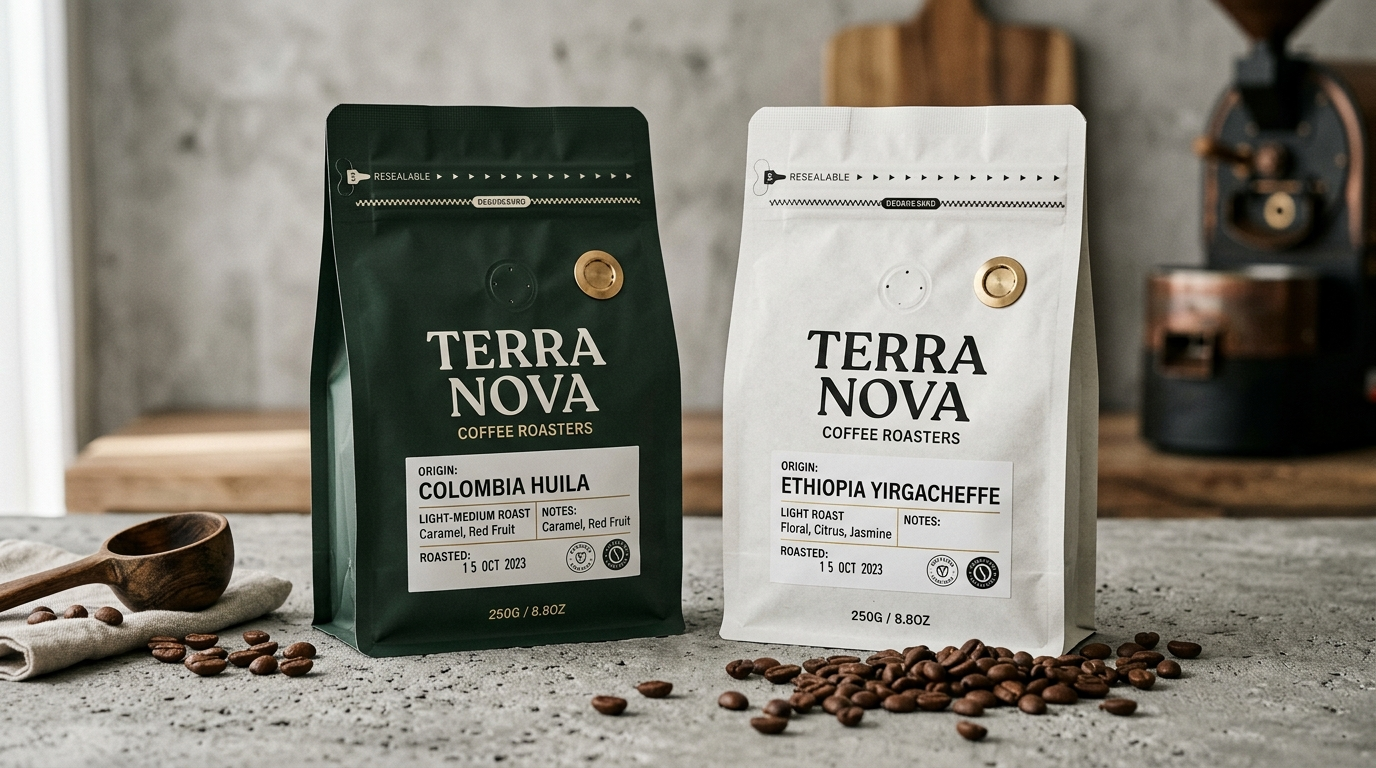
Coffee Packaging Degassing Valves & High-Barrier Pouches
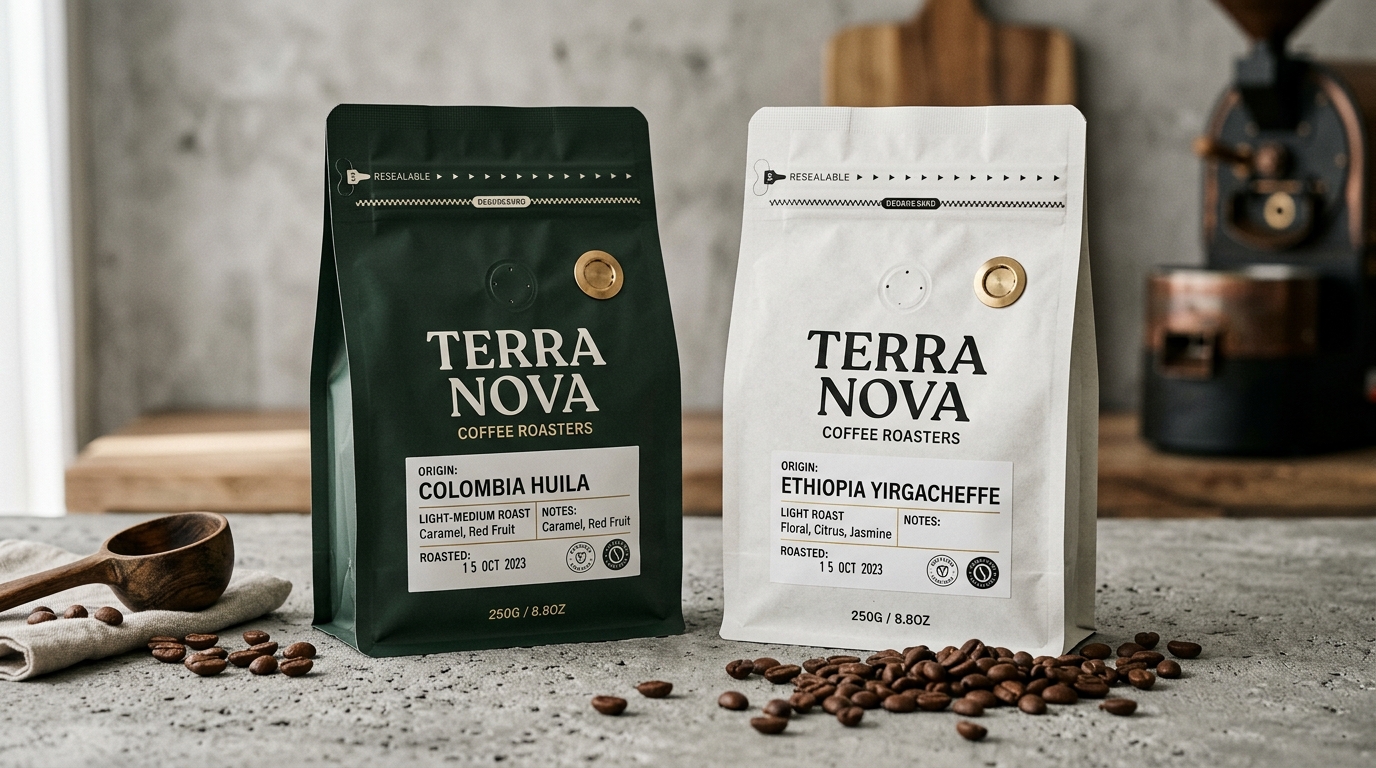
Freshly roasted coffee beans are biologically active. In the days following roasting, coffee undergoes intense off-gassing, releasing significant volumes of carbon dioxide ($CO_2$) alongside delicate aromatic volatile compounds. If sealed in an airtight pouch without ventilation, the accumulated gas pressure causes package ballooning or seal bursts. Conversely, exposure to ambient oxygen ($O_2$) and moisture degrades bean aromatics within days.
For specialty roasters and coffee brands, resolving this packaging dilemma requires two synchronized components: a one-way degassing valve and a high-barrier laminate pouch.
This technical guide breaks down the science of coffee off-gassing, how one-way valves operate, and how to select the right barrier films to maximize roasted coffee shelf life.
The Chemistry of Off-Gassing: Why Coffee Pouches Swell
During roasting, thermal degradation of carbohydrates and sugars generates carbon dioxide inside the cellular structure of coffee beans.
- Gas Volume: A single kilogram of freshly roasted coffee can generate between 2 to 5 liters of $CO_2$ over 1 to 2 weeks.
- Off-Gassing Curve: Peak gas emission occurs within the first 24 to 72 hours, tapering gradually over several weeks.
- The Oxygen Threat: Oxygen accelerates staling through lipid oxidation, turning delicate floral and citrus notes flat or rancid. Moisture absorption compromises bean crispness and bean density.
Traditional open venting lets carbon dioxide escape but admits atmospheric oxygen. The industry standard solution is the one-way degassing valve.
How One-Way Degassing Valves Work
A one-way degassing valve operates as a sensitive, pressure-actuated mechanical diaphragm:
- Internal Pressure Build-Up: As the roasted beans release $CO_2$, internal pressure inside the sealed pouch rises above atmospheric pressure.
- Valve Opening (Relief Cycle): When pressure reaches approximately 2 to 7 millibar (mbar), the internal diaphragm lifts off its silicone oil seal, allowing excess $CO_2$ to vent outside.
- Hermetic Resealing: As pressure equalizes, the elastic diaphragm immediately returns to its seat. The micro-layer of sealant oil creates a hermetic seal that prevents outside oxygen, moisture, and odors from entering the pouch.
Internal Valves vs External Valves
- Internal Heat-Sealed Valves: Applied to the inner film layer during pouch manufacturing via heat and ultrasonic sealing, with micro-pinholes pierced through the outer laminate. These provide a clean, invisible exterior presentation preferred for high-end specialty retail.
- External Heat-Sealed Valves: Applied to the outside of pre-made bags, often utilized in manual short-run operations.
Multi-Layer Barrier Structures for Coffee Pouches
A degassing valve can only protect the coffee if the surrounding bag material prevents gas transmission through its walls. Coffee pouches require balanced multi-layer laminates:
1. Traditional Foil Laminates (PET / AL / PE)
- Structure: Outer printed layer (PET or Kraft Paper) + Pure Aluminum Foil Barrier (AL, 7–9 µm) + Inner Heat-Seal Layer (Linear Low-Density Polyethylene, LLDPE).
- Performance: Provides near-zero Oxygen Transmission Rate (OTR < 0.1 cc/m²/24hr) and Water Vapor Transmission Rate (WVTR < 0.1 g/m²/24hr).
- Best Suited For: Long-shelf-life retail coffee, international distribution, and sensitive light-roast single origins.
2. Metallized Film Structures (Kraft / VMPET / PE)
- Structure: Outer Natural Kraft or Matte BOPP + Vacuum Metallized PET (VMPET) + LLDPE.
- Performance: Delivers substantial barrier protection with excellent tactile appeal at reduced cost and weight compared to solid foil.
- Best Suited For: Local roasteries, direct-to-consumer subscription shipments, and quick-turnaround cafe sales.
3. High-Barrier Recyclable Mono-Materials (MDO-PE / EVOH-PE)
- Structure: Oriented Polyethylene (MDO-PE) + EVOH barrier layer + Sealable PE.
- Performance: Replaces unrecyclable mixed-metal laminates with a mono-material structure suitable for PE recycling streams while retaining high oxygen barrier.
- Best Suited For: Eco-conscious coffee brands complying with European and North American circular economy regulations.
Choosing the Ideal Pouch Format for Coffee
| Pouch Format | Primary Advantages | Typical Bag Capacity |
|---|---|---|
| Stand-Up Pouches | Bottom gusset provides stable shelf footprint; lower material cost; popular 250g / 12oz retail standard | 100g to 500g (3.5oz to 16oz) |
| Flat Bottom Bags | True box-like base with five printable panels; maximizes premium shelf presence and upright stability | 250g to 1kg (12oz to 2.2lbs) |
| Side Gusset Bags | Traditional classic format; high volume efficiency for bulk beans; versatile top fold or tin-tie options | 500g to 2.5kg (1lb to 5lbs) |
Quality Checklist for Sourcing Custom Coffee Packaging
When ordering custom printed coffee bags from a packaging supplier, verify the following specifications:
- Valve Placement Precision: Ensure the valve position does not interfere with the zipper track, heat seal line, or critical brand artwork elements.
- Zipper Type: For whole bean and ground coffee, specify a powder-proof pocket zipper or pull-tab tear zipper to ensure easy reopening and reliable resealing by consumers.
- Seal Integrity Testing: Request vacuum leak decay and seal-strength test reports to confirm the pouch holds integrity during air freight decompression.
Get Expert Custom Coffee Packaging Solutions
Whether you need custom-printed stand-up pouches, premium flat bottom bags, or certified barrier materials with integrated one-way degassing valves, the CraftPack Global Team engineers high-performance packaging tailored to your roast profiles and brand aesthetics.