
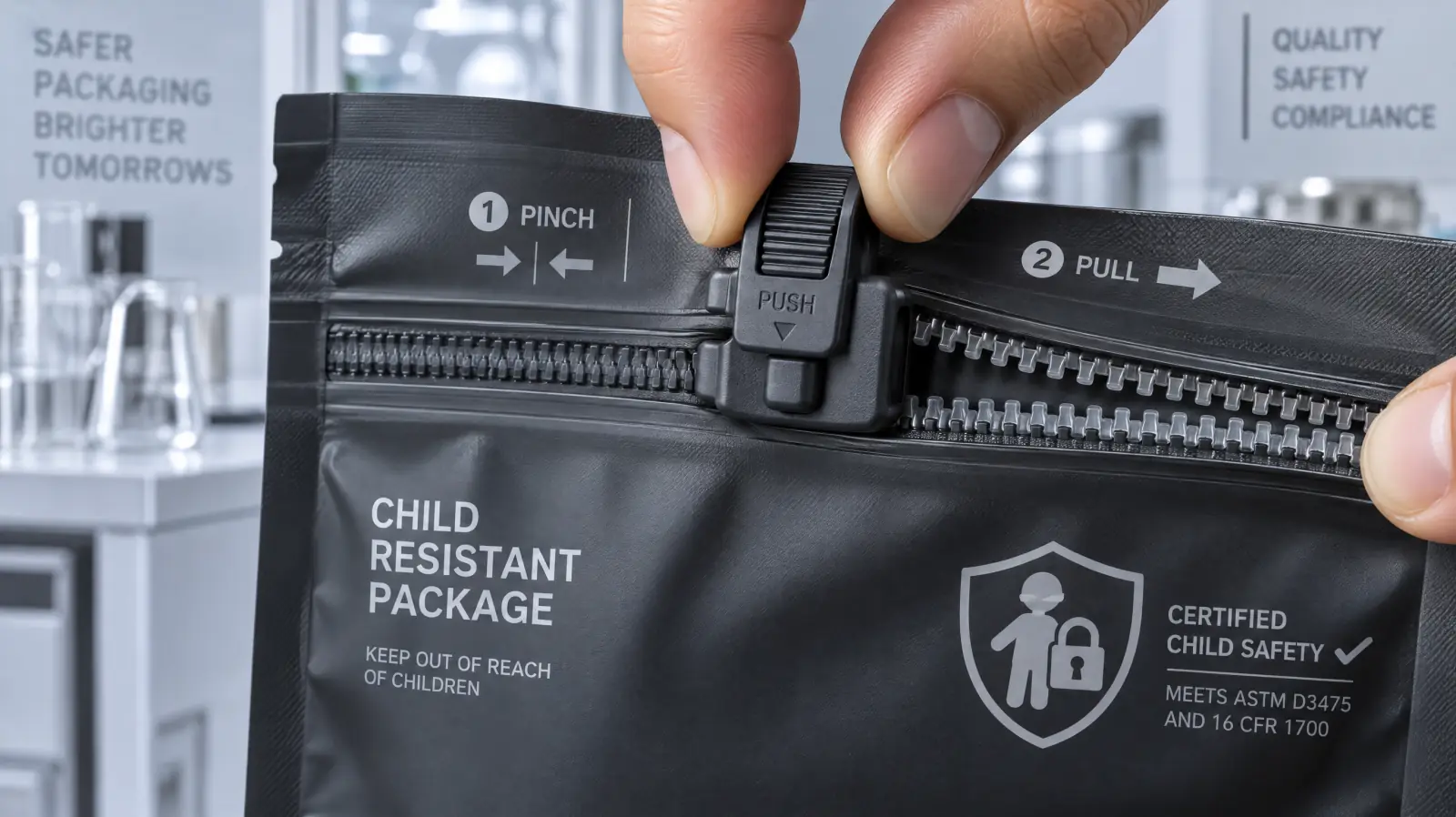
Child-Resistant Pouch Zippers: ASTM D3475 & 16 CFR 1700.20 Guide
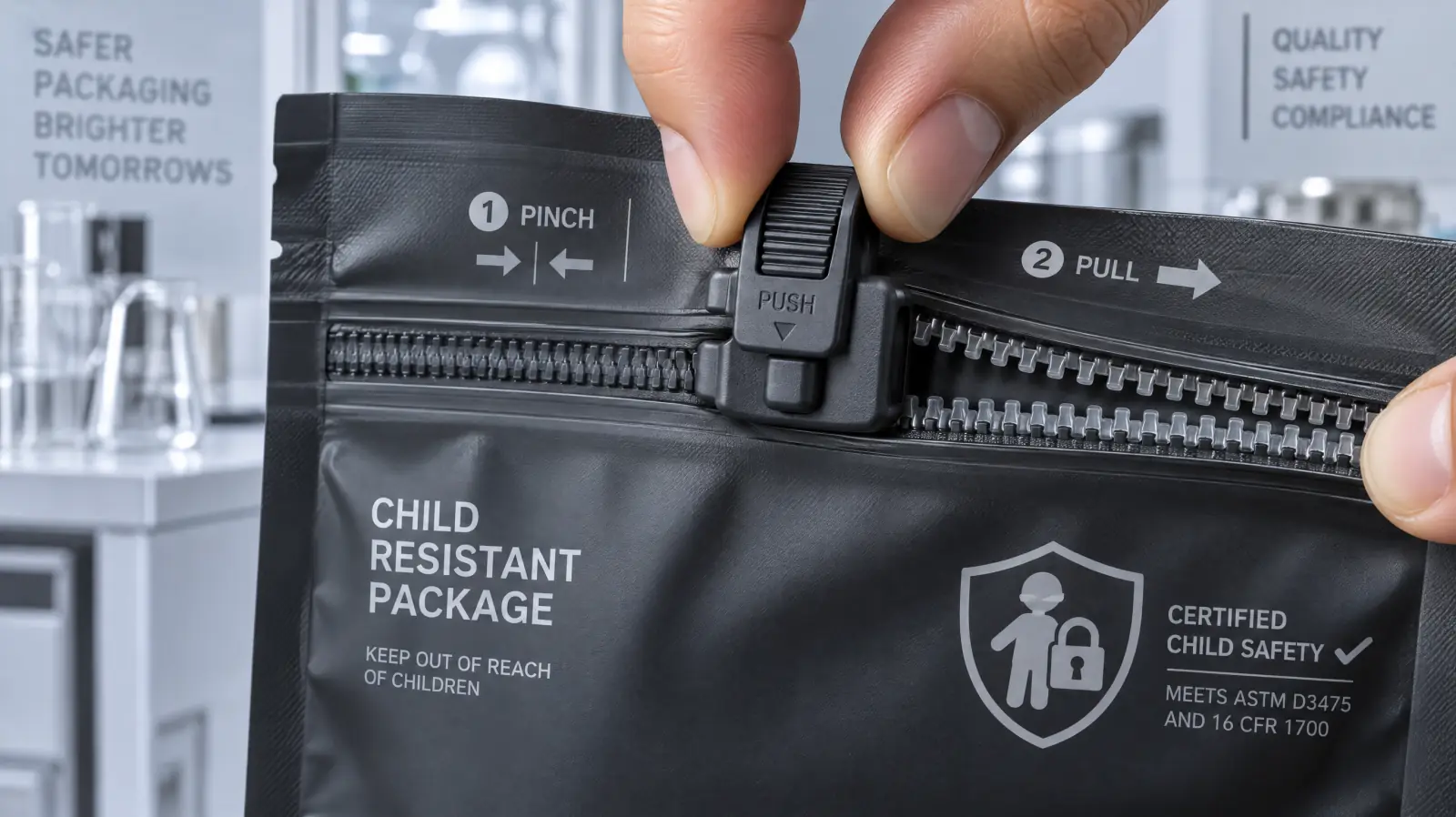
Child-resistant (CR) packaging is no longer confined to rigid amber pill vials and blow-molded medicine bottles. As consumer packaged goods (CPG), nutraceuticals, household detergents (such as concentrated laundry pods), lawn chemicals, and legal cannabis products transition rapidly to lightweight flexible pouches, engineering certified Child-Resistant Flexible Packaging (CRFP) has become a top regulatory and legal priority.
A failure in closure engineering does not merely risk product moisture loss or contamination—it can trigger catastrophic product recalls, severe fines from consumer safety commissions, and genuine hazard to young children.
Designing an effective child-resistant flexible pouch requires balancing two opposing engineering requirements:
- Child Impedance: The package must reliably thwart 80% to 85% of children under 51 months from opening the closure within a 10-minute test.
- Senior Adult Usability: The closure must remain easily accessible to senior adults aged 50 to 70 without requiring scissors or tools.
This technical guide dissects child-resistant zipper profiles, the mechanical physics of lock mechanisms, certification testing under 16 CFR § 1700.20 and ASTM D3475, and pouch seal integrity.
1. Quick Engineering Comparison: Child-Resistant Closure Types
| Closure Architecture | Push-and-Slide Mechanical Slider | Pinch-and-Pull Internal Tab | Dual-Hand Dexterity Zipper |
|---|---|---|---|
| Mechanical Action Required | Depress locking catch while sliding car across track | Blind pinch of concealed internal grip flap while pulling front lip | Symmetrical two-hand opposed peel with thumb-lever unlock |
| Cognitive Requirement | High (two simultaneous dissimilar motions) | High (hidden tactile feature requiring spatial reasoning) | Moderate (counter-intuitive opening force angle) |
| Adult Senior Acceptance (SAUE) | Highest (95%–98% within 60s) | Moderate (requires clear visual printed instructions) | High (intuitive once finger placement is understood) |
| Pouch Converting Line Speed | Moderate (slider application station inline or pre-applied) | High (standard zipper guide insertion rolls) | High (continuous profile heat sealing) |
| Aroma & Gas Barrier Tightness | High (requires hermetic end-stops) | Extreme (continuous coextruded seal lips) | Very High |
| Typical CPG Applications | Laundry detergent pods, dish tabs, pool chemicals | Pharmaceuticals, medical gummies, unit-dose powders | Agrochemicals, botanical extracts, lawn treatments |
Review complementary closure engineering in our Spout Fitment Engineering Guide and Stand-Up Pouches Category.
2. Regulatory Compliance: 16 CFR § 1700.20 & ASTM D3475
In the United States and international markets adopting ISO 8317 or ASTM standards, child-resistant compliance is determined through rigorous statistical human panel testing:
┌────────────────────────────────────────────────────────────────────────┐
│               ASTM D3475 / 16 CFR § 1700.20 PANEL PROTOCOL             │
├───────────────────────────────────┬────────────────────────────────────┤
│         CHILD TEST PANEL          │      SENIOR ADULT PANEL (SAUE)     │
│        (Ages 42 – 51 Months)      │          (Ages 50 – 70 Years)      │
├───────────────────────────────────┼────────────────────────────────────┤
│                                   │                                    │
│   • 200 children tested in pairs  │   • 100 seniors tested individually│
│   • 5 Minutes uninstructed attempt│   • 5 Minutes initial attempt:     │
│     Target: ≥ 85% must FAIL to    │     Target: ≥ 90% must SUCCEED to  │
│     access package contents       │     open and reclose without tools │
│   • 5 Minutes after visual demo:  │   • 1 Minute second attempt:       │
│     Target: ≥ 80% must FAIL       │     Must successfully re-open      │
│                                   │                                    │
│   PASS CRITERIA:                  │   PASS CRITERIA:                   │
│   Package remains closed to ≥80%  │   Package accessible to ≥90%       │
│   of tested children overall      │   of senior adults without strain  │
│                                   │                                    │
└───────────────────────────────────┴────────────────────────────────────┘
The Mechanism of Child Failure
Cognitive developmental psychology reveals that children under 5 years old lack the spatial coordination to perform two simultaneous, dissociated mechanical actions.
- For a push-and-slide slider, the child cannot maintain downward compressive force on a miniature spring-loaded button while exerting lateral sliding force.
- For a hidden-tab zipper, the child lacks the sensory anticipation to search for a recessed, uncolored inner flap while pulling the exterior wall.
3. Structural Mechanics: Inside the CR Zipper Profiles
PUSH-AND-SLIDE MECHANICAL SLIDER
┌──────────────────────────────────────────────────────────────┐
│                  [ LOCKING DETENT ]                          │
│                         ▼                                    │
│   ┌───────────────────[PIN]───────────────────┐              │
│   │  SLIDER CARRIAGE                          │ ──► SLIDE     │
│   └───────────────────────────────────────────┘              │
│         ▲                                                    │
│    PRESS DOWN (Unlocks track gate)                           │
└──────────────────────────────────────────────────────────────┘

PINCH-AND-PULL HIDDEN RECESSED FLAP
┌──────────────────────────────────────────────────────────────┐
│   Exterior Pouch Wall (Front)                                │
│   ┌──────────────────────────────────────────────────────┐   │
│   │ [GRIP NOTCH]                                         │   │
│   └──────────────────────────────────────────────────────┘   │
│       │                                                      │
│       ▼                                                      │
│   ┌───────────────────────────────────┐                      │
│   │ [INTERNAL CONCEALED FLAP]         │ ◄── PINCH HERE       │
│   │ (Offset by 12mm below front edge) │     WHILE PULLING    │
│   └───────────────────────────────────┘     FRONT WALL OUT   │
│   ▲ Male Profile Interlock                                   │
│   ▼ Female Profile Interlock                                 │
└──────────────────────────────────────────────────────────────┘
1. Push-and-Slide Slider Closures
The slider houses a micro-molded polycarbonate or high-density POM spring latch. In its resting state, an internal pin is lodged inside a molded groove on the zipper track. To open:
- The user must press an ergonomically textured pad downwards with a minimum threshold force of 8 to 12 Newtons.
- Simultaneously, the user slides the carriage horizontally to separate the interlocking male-female polyethylene tracks.
- At the end of travel, the slider clears the opening. When pushed back to close, an audible and tactile “click” signals re-engagement of the child safety lock.
2. Pinch-and-Pull Concealed Flap
Rather than adding rigid slider hardware, the pinch-and-pull mechanism relies on differential flap geometry:
- The exterior lip of the pouch appears identical to a standard zip pouch.
- Inside the front panel, an internal secondary flap of film is welded 10–15mm below the rim.
- If a child simply grabs both exterior edges and pulls outward with brute force, the tensile shear force directs inward, pulling the interlocking teeth even tighter together.
- Only when an adult pinches the concealed inner flap with one hand and pulls the exterior back panel with the other does the zipper peel open smoothly.
4. Pouch Barrier Laminate Engineering
Child-resistant packaging frequently contains high-potency, volatile, or chemically aggressive ingredients. The flexible laminate structure must prevent chemical delamination, moisture ingress, and odor escape:
┌────────────────────────────────────────────────────────────────────────┐
│        ULTRA-BARRIER CR LAMINATE FOR DETERGENTS & ACTIVE CPG           │
├───────┬────────────────────────────────────────────────────────────────┤
│ LAYER │ MATERIAL SPECIFICATION & FUNCTION                              │
├───────┼────────────────────────────────────────────────────────────────┤
│ Outer │ 12µm Biaxially Oriented Polyester (BOPET) - Print & Puncture   │
│ Inter │ 2-Part Polyurethane Adhesive (Aliphatic / Chemical Resistant)  │
│ Core  │ 7µm - 9µm Aluminum Foil (0.00 OTR / 0.00 WVTR Absolute Shield)│
│ Inter │ Tie Resin / Polyethylene Primer                                │
│ Inner │ 90µm - 120µm Linear Low-Density Polyethylene (LLDPE)           │
│       │ with High-Integrity Sealant & Anti-Stress-Cracking Resins      │
└───────┴────────────────────────────────────────────────────────────────┘- Chemical Resistance: Concentrated liquid detergent pods contain surfactants that can attack standard adhesives. A chemically inert polyurethane solventless lamination system prevents delamination.
- Puncture & Burst Protection: Pouch walls must withstand substantial compression during accidental step-on incidents. Laminates must deliver minimum Dart Drop Impact values > 450 grams per ASTM D1709.
Compare with our industrial sack strength standards in BOPP Woven Polypropylene Sacks Palletizing Guide.
5. Converting & Sealing Parameters for Package Integrity
A child-resistant zipper is only as strong as its side-seal weld. If the heat-seal jaws fail to achieve complete resin flow around the zipper profile, channels will form, allowing contents to leak:
- Ultrasonic Zipper Crush Pre-Sealing: Before the pouch perimeter is welded, high-frequency ultrasonic horns (20 kHz) focus energy specifically at the left and right ends of the zipper track. This collapses and flattens the thick plastic teeth into a thin, uniform resin film without burning the outer print layer.
- Side Seal Jaw Profile: Specialized segmented heat-seal bars deliver differential pressure: higher pressure over the zipper crush zone and balanced pressure across the film edges.
- Hermetic Tamper-Evident Header: ASTM D3475 certified flexible pouches feature a solid heat-seal header above the CR zipper with laser-perforated tear notches. The consumer tears off the top header on first use, proving the package was untampered with at retail.
6. Procurement & Qualification Checklist
When engineering child-resistant flexible packaging for your brand:
- Request Complete Test Certificates: Ensure third-party testing was executed in accredited US/EU laboratories (such as Perritt Laboratories or Child Related Research) with full demographic data.
- Specify Pouch Format: Determine whether Stand-Up Pouches or Flat Bottom Box Pouches best suit your product fill volume.
- Include Clear Graphical Instructions: Under 16 CFR § 1700.20, clear, indelible pictogram instructions (e.g., “Push Down & Slide” or “Pinch Flap & Pull”) must be printed conspicuously on the front or header of the package.
- Conduct Real-World Shelf-Life Stability: Test the interaction between active ingredients and the inner LLDPE zipper resin to ensure plasticizers do not soften the zipper teeth over 12 months.
Partner with CraftPack Global for Certified Safety Packaging
CraftPack Global manufactures ASTM D3475 and 16 CFR § 1700 compliant flexible pouches featuring high-reliability slider mechanisms, concealed pinch-and-pull profiles, and high-barrier foil laminations.
Contact Our Packaging Engineering Team to request certified CR pouch samples, technical dielines, and regulatory compliance dossiers.