
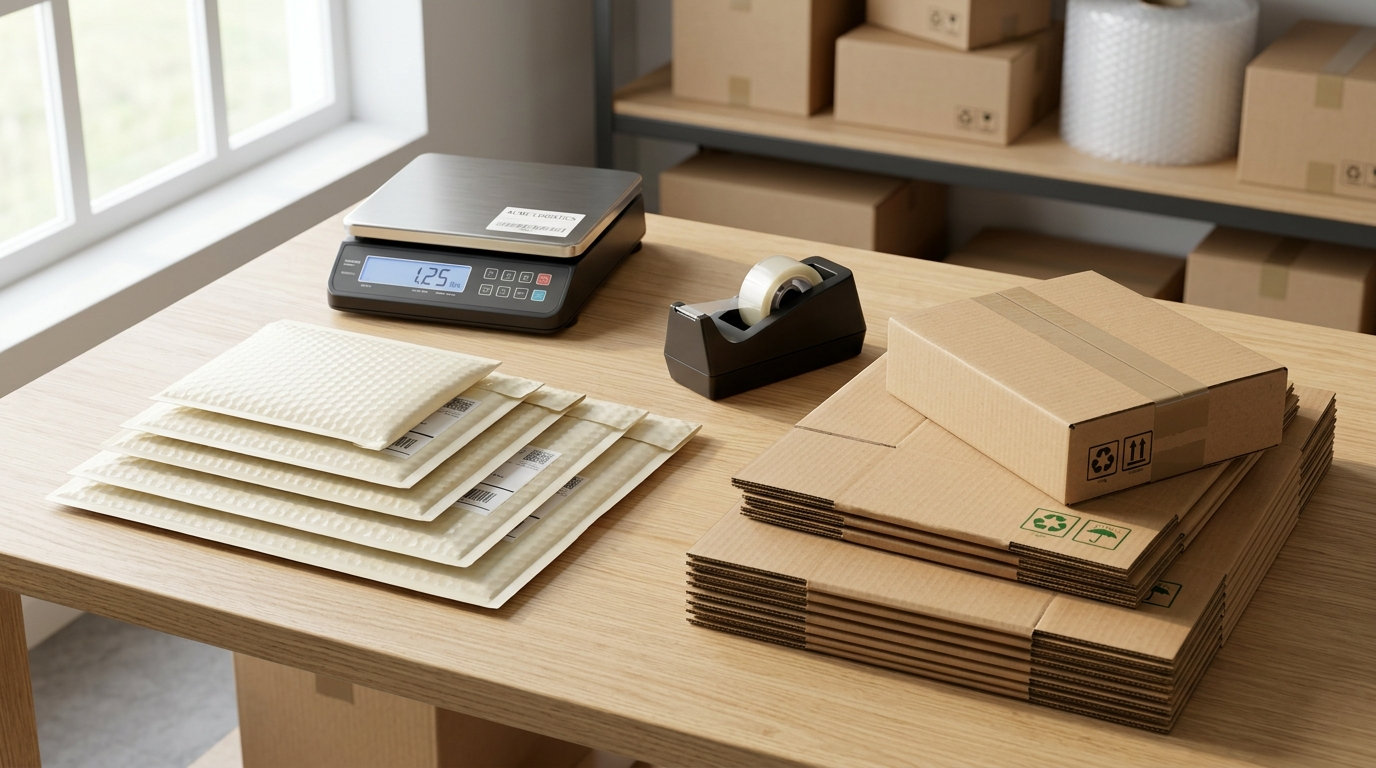
Bubble Mailers vs Corrugated Boxes: DIM Weight Cost Guide
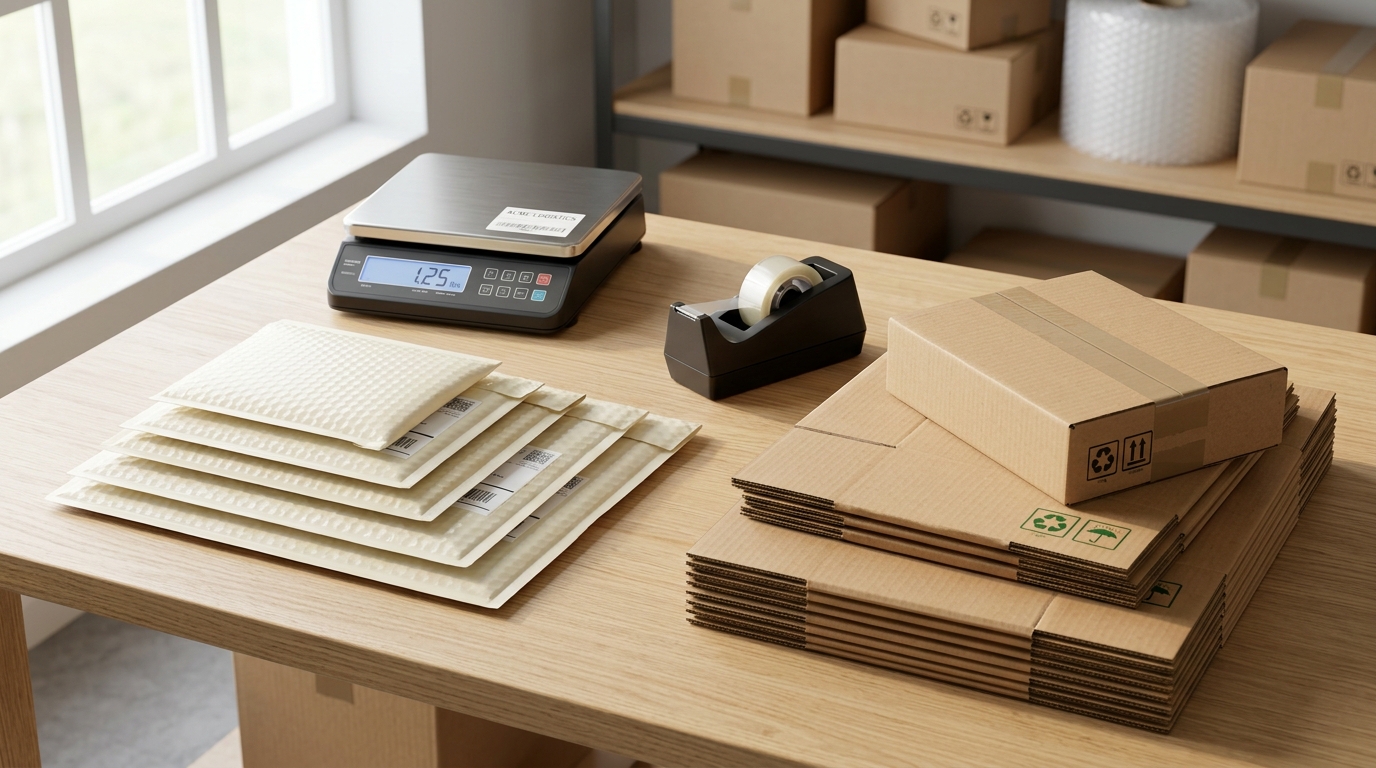
For e-commerce brands and direct-to-consumer retailers, shipping costs represent one of the largest ongoing operational expenses. Major cross-border logistics carriers—including FedEx, UPS, DHL, and national postal networks—bill freight using Dimensional Weight (DIM weight) pricing formulas rather than actual scale weight whenever a package is relatively light for its size.
When packaging jewelry, cosmetics, apparel accessories, phone cases, or small electronics, choosing between a padded bubble mailer and a rigid corrugated box directly dictates whether you pay minimum baseline rates or trigger expensive dimensional surcharges.
This guide provides a detailed operational and financial breakdown comparing bubble mailers and corrugated boxes, showing how to calculate true shipping costs and optimize fulfillment efficiency.
How Dimensional Weight (DIM Weight) Multiplies Freight Costs
Carriers calculate billable shipping weight by comparing two figures and charging whichever is greater:
- Actual Scale Weight: The physical weight of the package in pounds or kilograms.
- Dimensional Weight: The volumetric size calculated using standard industry divisors:
$$\text{DIM Weight (lbs)} = \frac{\text{Length (in)} \times \text{Width (in)} \times \text{Height (in)}}{139 \text{ (or } 166 \text{ for retail)}}$$
$$\text{DIM Weight (kg)} = \frac{\text{Length (cm)} \times \text{Width (cm)} \times \text{Height (cm)}}{5000}$$
A Practical Cost Calculation Example
Consider a lightweight pair of designer sunglasses weighing 0.25 kg (0.55 lbs):
- Packed in a Corrugated Box ($22 \times 16 \times 9\text{ cm}$):
- Volumetric volume: $3,168\text{ cm}^3$
- DIM weight ($/ 5000$): 0.63 kg
- Billable weight: 0.63 kg (More than $2.5\times$ the actual physical weight).
- Packed in a Cushioned Bubble Mailer ($22 \times 16 \times 2\text{ cm}$):
- Volumetric volume: $704\text{ cm}^3$
- DIM weight ($/ 5000$): 0.14 kg
- Billable weight: 0.25 kg (Billed purely on minimum actual weight).
Across thousands of monthly cross-border parcels, shifting suitable products from rigid boxes to flexible padded mailers can reduce total logistics spend by 20% to 35%.
Side-by-Side Comparison: Bubble Mailers vs Corrugated Boxes
| Evaluation Factor | Custom Bubble Mailers | Rigid Corrugated Mailer Boxes |
|---|---|---|
| Tare Packaging Weight | Extremely light (15–30g) | Moderate (80–180g) |
| Dimensional Volume | Conforms tightly around product profile | Fixed rigid exterior volume with internal empty void |
| Inbound Storage Volume | Takes 60–75% less pallet space in warehouse | Bulky; takes substantial staging area even when flat |
| Packing Fulfillment Speed | Fast: Insert item, peel adhesive liner, press seal (5–8s) | Slower: Fold box, insert product, add void fill, tape (20–35s) |
| Surface Puncture Resistance | Moisture-proof poly or tear-resistant kraft exterior | High puncture resistance, high stack rigidity |
| Crush / Compression Defense | Cushioning against drops; low top-load crush support | High vertical compression strength (resists stacking load) |
| Unboxing Brand Presentation | Practical, functional e-commerce aesthetic | Premium tactile presentation, sharp structural edges |
Structural Protection: When Bubble Mailers Fall Short
While bubble mailers deliver massive volumetric savings, they provide cushioning, not structural crush resistance.
- The Bubble Lining: Trapped air cells absorb shock from drops and vibrational friction during transport.
- The Vulnerability: Under heavy conveyor sorting rollers or stacked under heavy parcels in transit cages, flexible mailers yield to external pressure.
Choose Custom Bubble Mailers When:
- Products have inherent structural durability: apparel, textiles, soft leather goods, silicone accessories, books, and pre-boxed small items.
- Primary transit hazards are scratches, surface scuffs, and moisture penetration rather than crushing.
- Order fulfillment speed and warehouse storage space are critical operational constraints.
- Explore compatible shipping envelopes in our e-commerce mailers category.
Choose Corrugated Boxes When:
- Shipping fragile, brittle, or pressure-sensitive products: glass cosmetic dropper bottles, ceramics, delicate electronics, or unboxed luxury eyewear.
- Products require precise presentation compartments or rigid structural unboxing experiences.
- Multi-item bundled orders where products of differing shapes and weights would slide against each other.
- Consider combining rigid mailers with interior custom printed gift bags or paper shopping bags to create a premium luxury unboxing journey.
Operational Strategies to Maximize Freight Efficiency
- Adopt a Dual-Stream Packaging Workflow: Avoid forcing all SKUs into a single carton size. Configure your warehouse management system (WMS) to assign soft and durable items automatically to custom bubble mailers while routing crush-sensitive goods to right-sized boxes.
- Utilize Tamper-Evident Self-Seal Strips: Select mailers featuring high-tack hot-melt adhesive closures that tear the substrate upon opening, discouraging opportunistic theft during transit.
- Upgrade to High-Slip Inner Bubble Liners: Multi-layer bubble mailers manufactured with high-slip inner liners enable pickers to slide goods inside smoothly, accelerating packaging line throughput.
- Brand Your Mailer Exterior: Custom Pantone printing, matte exterior finishes, and branded tear strips transform an ordinary shipping mailer into an intentional brand touchpoint without adding weight.
Optimize Your E-Commerce Packaging with CraftPack Global
Balancing shipping freight rates, transit damage rates, and customer unboxing experience requires precision packaging design. Whether you require custom-printed bubble mailers, sustainable compostable shipping mailers, or engineered rigid boxes, contact the CraftPack Global Team to request dielines, material swatches, and factory-direct volume pricing.