
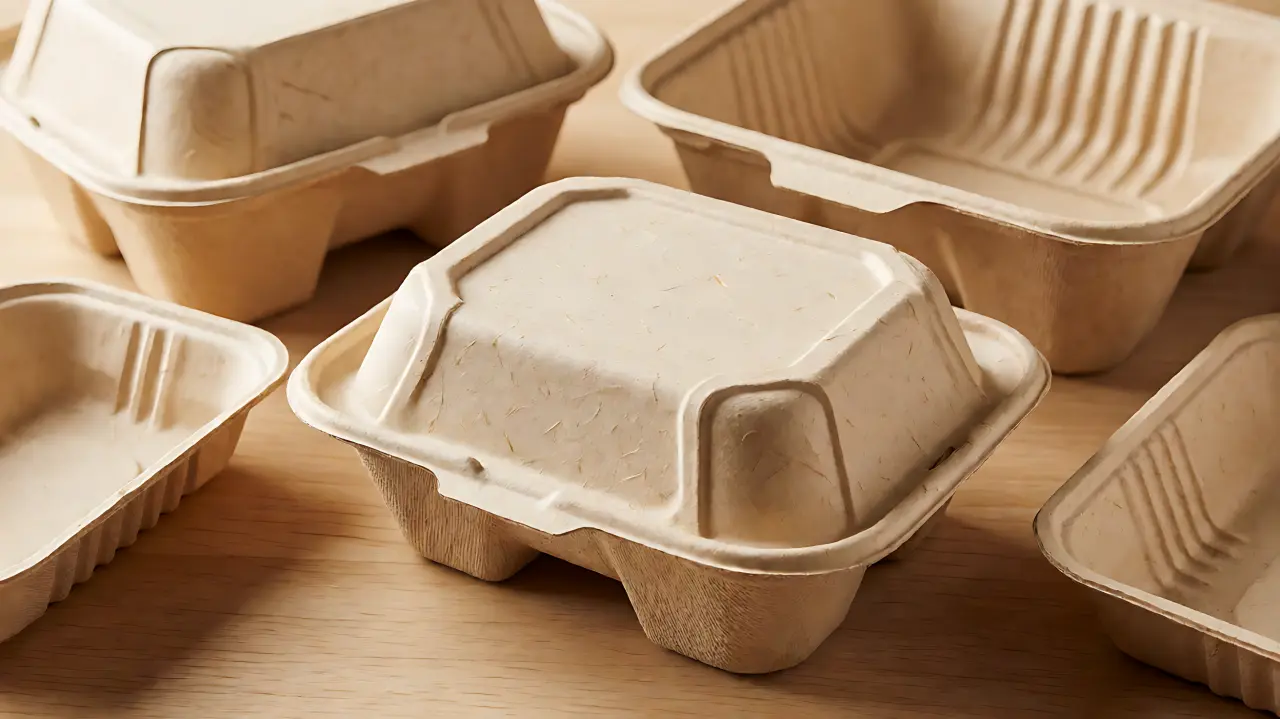
Bagasse vs Bamboo Molded Pulp Food Packaging: Fiber Mechanics
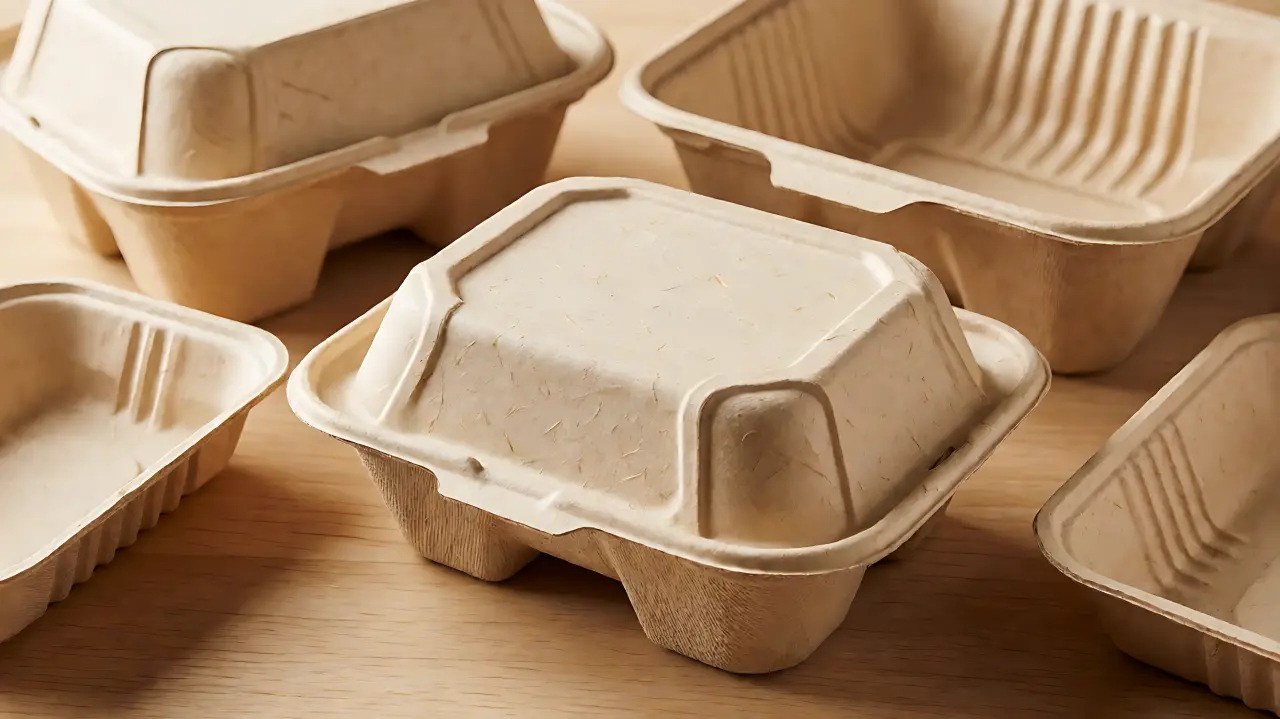
In the global transition away from expanded polystyrene (EPS) foam clamshells and plastic single-use food service packaging, Thermoformed Molded Fiber (Molded Pulp) has emerged as the premier plant-based alternative. Restaurant chains, commercial catering operators, and food delivery platforms increasingly demand rigid, compostable, and plastic-free clamshells, bowls, and meal trays.
However, not all plant fibers perform identically under commercial catering conditions. The two preeminent agro-waste and renewable feedstocks are Sugarcane Bagasse and Bamboo Fiber. Selecting between them requires examining fiber morphology, hydrogen bonding density, PFAS-free grease resistance (TAPPI T559), and structural wall rigidity under steaming hot food loads.
Fiber Morphology & Hydrogen Bonding Physics
Sugarcane Bagasse Fiber Matrix               Bamboo Long-Fiber Network
┌───────────────────────────────────────┐   ┌───────────────────────────────────────┐
│ Short Parenchyma Cells & Fibers       │   │ Slender Tracheid Fibers (1.5 - 3.5 mm)│
│ (Length: 1.0 - 1.7 mm; Width: ~20 µm) │   │ High Slenderness (Aspect) Ratio > 100 │
├───────────────────────────────────────┤   ├───────────────────────────────────────┤
│ Moderate Aspect Ratio (L/D ~ 65)      │   │ High Tensile Index (65 - 85 N·m/g)    │
├───────────────────────────────────────┤   ├───────────────────────────────────────┤
│ Dense Surface Compaction; Smooth Hand │   │ Robust Entanglement Network; Anti-Sag │
├───────────────────────────────────────┤   ├───────────────────────────────────────┤
│ High Pith Content (Requires Depithing)│   │ High Mechanical Toughness / Rigidity  │
└───────────────────────────────────────┘   └───────────────────────────────────────┘
                 ▼                                              ▼
   Silky, refined surface finish;              Superior flexural modulus & beam strength;
   Cost-effective agricultural byproduct.      Withstands heavy wet sauces without collapse.
1. Sugarcane Bagasse Pulp Chemistry
- Agro-Industrial Byproduct: Sourced from the crushed residual stalks of sugarcane (Saccharum officinarum) following sugar juice extraction. It contains approximately $40% - 45%$ cellulose, $30% - 35%$ hemicellulose, and $18% - 22%$ lignin.
- Fiber Morphology: Possesses relatively short, thick-walled fibers ($1.0 - 1.7,\text{mm}$ mean length) mixed with non-fibrous parenchyma pith cells. Industrial pulp mills deploy mechanical wet-depithing systems to remove $> 85%$ of the pith, ensuring high wet-web drainage speeds on rotary forming molds.
- Surface Density & Texture: When hot-pressed in CNC-machined metal molds under high pressure ($0.8 - 1.5,\text{MPa}$) and temperatures ($160^\circ\text{C} - 200^\circ\text{C}$), bagasse fibers collapse into a smooth, ivory-white, highly compacted surface with minimal tactile graininess.
2. Bamboo Fiber Mechanics
- Fast-Growing Hardwood Mimic: Sourced from rapidly maturing bamboo culms (Phyllostachys pubescens), which reach industrial maturity within 3 to 5 years without replanting.
- Long Slender Tracheids: Bamboo fibers feature an extraordinary average length of $1.8 - 3.5,\text{mm}$ and an aspect ratio (length-to-diameter, $L/D$) exceeding $100:1$, closely resembling virgin softwood kraft fibers.
- Entanglement Toughness: During thermoforming, these elongated, flexible fibers weave into a resilient 3D skeletal network. Even under high moisture vapor exposure, the cross-linked hydrogen bonds resist fiber sliding, preventing the soggy bottom sagging common in low-density containers.
Mechanical Rigidity & Moisture Sorption Dynamics
Molded pulp structural beam deflection under food mass follows classical bending stiffness equations:
$$S_b = \frac{E \cdot t^3}{12}$$
Where bending stiffness ($S_b$) is proportional to the elastic modulus ($E$) and the cube of the wall caliper ($t^3$):
| Engineering Property | 100% Sugarcane Bagasse | 100% Bamboo Fiber | 70/30 Bagasse/Bamboo Blend | Standard Protocol |
|---|---|---|---|---|
| Mean Fiber Length | $1.2 - 1.5,\text{mm}$ | $2.2 - 3.2,\text{mm}$ | $1.5 - 2.0,\text{mm}$ | Fiber Quality Analyzer (FQA) |
| Tensile Index (Dry) | $45 - 58,\text{N}\cdot\text{m/g}$ | $72 - 88,\text{N}\cdot\text{m/g}$ | $60 - 72,\text{N}\cdot\text{m/g}$ | ISO 1924-2 |
| Bending Stiffness Index | $1.2 - 1.6,\text{mN}\cdot\text{m}$ | $2.1 - 2.8,\text{mN}\cdot\text{m}$ | $1.7 - 2.2,\text{mN}\cdot\text{m}$ | ISO 5628 / Taber |
| Cobb 180 Water Absorption | $35 - 55,\text{g/m}^2$ | $28 - 42,\text{g/m}^2$ | $30 - 45,\text{g/m}^2$ | TAPPI T441 ($180,\text{s}$) |
| Hot Oil Resistance (95°C) | $> 30,\text{minutes}$ | $> 45,\text{minutes}$ | $> 35,\text{minutes}$ | ASTM F119 / Oil Holdout |
| Surface Smoothness (Bekk) | $25 - 45,\text{seconds}$ | $12 - 25,\text{seconds}$ | $20 - 35,\text{seconds}$ | ISO 5627 |
| Natural Unbleached Hue | Warm Cream / Light Tan | Rich Golden Kraft Brown | Light Amber / Buff | Colorimeter $L^*a^b^$ |
| Compostability Timeline | $< 90\text{ days}$ (Industrial) | $< 90\text{ days}$ (Industrial) | $< 90\text{ days}$ (Industrial) | EN 13432 / ASTM D6400 |
The PFAS-Free Functional Barrier Transition
Historically, molded fiber mills added fluorochemicals (per- and polyfluoroalkyl substances, PFAS) to wet pulp slurries to lower surface energy and repel hot cooking oils. With sweeping global bans (US FDA restrictions and European REACH/PPWR bans), converters deploy PFAS-Free Water-Dispersed Barrier Chemistry:
- Aqueous Bio-Polymer Sizing: Wet-end addition of alkyl ketene dimer (AKD) or modified cationic starch paired with vegetable-oil-derived or bio-wax micro-emulsions.
- Post-Forming Spray / Extrusion Coating: Automated robotic sprayers deposit a continuous micro-layer ($5 - 12,\mu\text{m}$) of water-based acrylic, polylactic acid (PLA), or polyhydroxyalkanoate (PHA) over the inner food-contact surface.
- Performance Target: Achieves TAPPI T559 Kit Rating of Kit 7 to Kit 9 without synthetic fluorocarbons, resisting boiling soups, hot chili oils, and microwave reheating ($100^\circ\text{C}$ for $15,\text{min}$) without liquid seepage or staining.
Procurement & Formulation Recommendation
- Specify 100% Bagasse: For delicate bakery pastries, dessert clamshells, burger boxes, and coffee cup lids where optical brightness, smooth white aesthetics, and cost optimization are central.
- Specify Bamboo or Bamboo-Rich Blends (e.g., 70/30): For heavy institutional food service trays, steaming ramen bowls, hot curry delivery containers, and industrial catering platters requiring high rim rigidity, stackability, and zero deformation under steaming moisture loads.
Explore our certified food service paper bags and custom paper shopping bags. Partner with CraftPack Global to engineer precision thermoformed molded fiber packaging certified to global PFAS-free and compostability standards.