
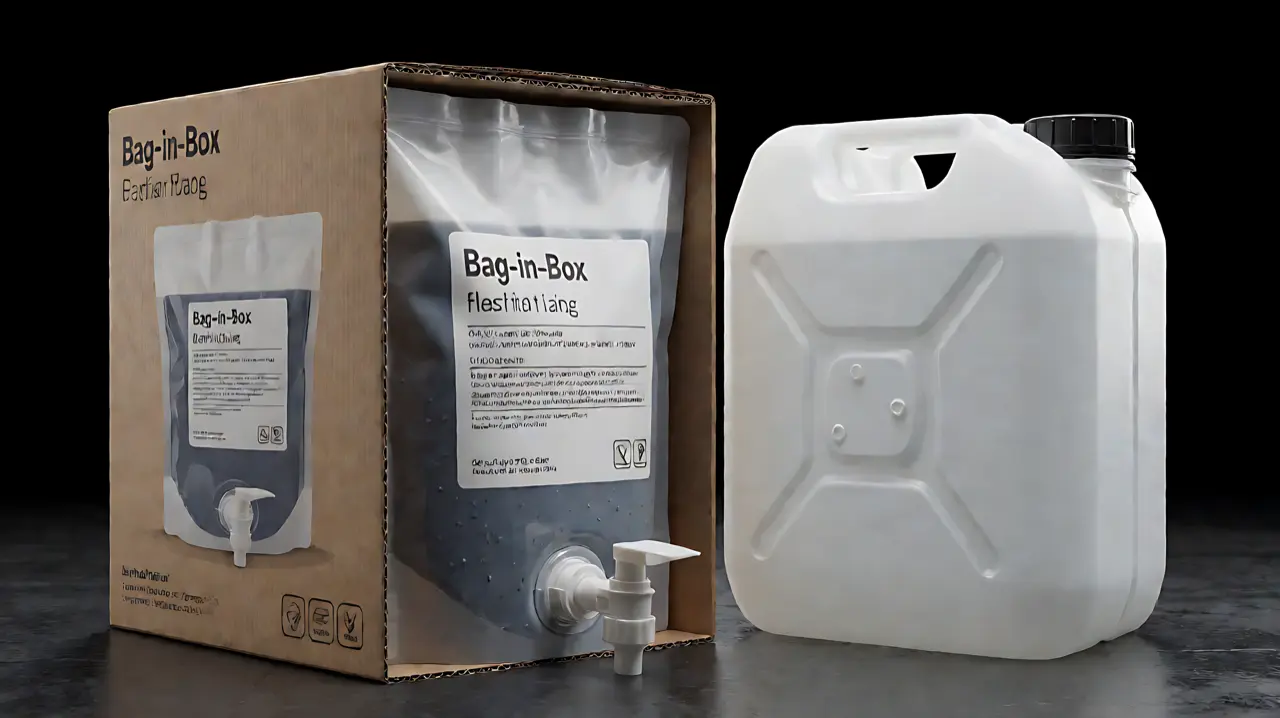
Bag-in-Box vs Rigid Drums: Liquid Packaging Guide
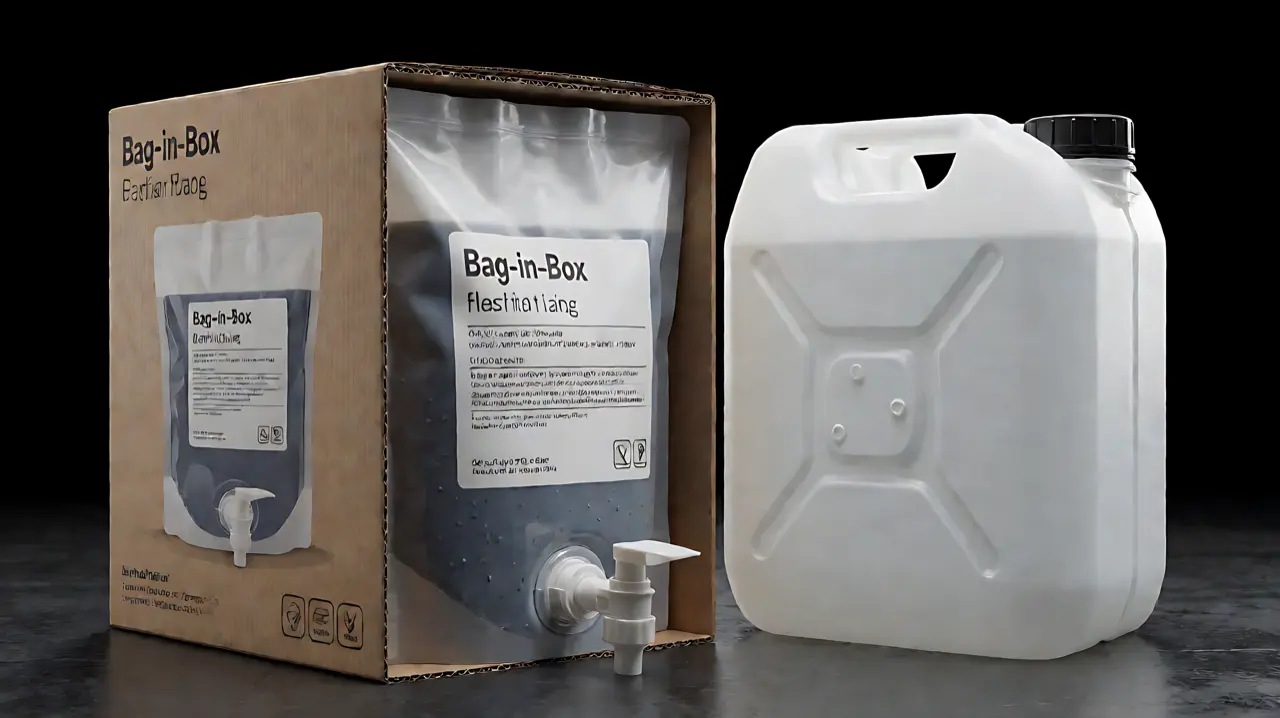
For commercial beverage producers, edible oil processors, liquid egg suppliers, and industrial chemical manufacturers, bulk liquid packaging represents a substantial portion of logistical overhead and product spoilage risk. Historically, rigid High-Density Polyethylene (HDPE) jerrycans (5L to 25L) and steel or plastic drums (200L) served as the default bulk containers. However, the rise of Bag-in-Box (BIB) flexible packaging has upended commercial distribution economics.
A Bag-in-Box system pairs a multi-layer flexible barrier bladder—constructed from co-extruded EVOH, metallized polyester (Met-PET), or biaxially oriented nylon (BOPA)—with a structural corrugated outer box and an airtight dispensing fitment (such as Vitop or Scholle IPN taps). Unlike rigid containers that draw in ambient air as liquid is dispensed, a flexible BIB bladder collapses continuously around the remaining liquid, preventing headspace oxidation and extending open-tap freshness from days to weeks.
This engineering guide examines the functional trade-offs between Bag-in-Box systems and rigid containers across oxygen transmission, cube utilization, dispensing mechanics, warehouse freight, and lifecycle carbon emissions.
1. Engineering Comparison: Bag-in-Box vs. Rigid HDPE Jerrycans & Steel Drums
| Parameter / Metric | Bag-in-Box (BIB) Multi-Layer | Rigid HDPE Jerrycan (UN-Rated) | Rigid Steel Drum (Tight-Head) |
|---|---|---|---|
| Primary Material | EVOH/LLDPE or Met-PET/PE liner + Flute Corrugated | Extruded HDPE (Blow molded) | Cold-Rolled Carbon Steel (1.0–1.2 mm) |
| Empty Packaging Weight (20L) | ~350 g (85g bag + 265g box) | ~1,100 g to 1,450 g | ~4,200 g to 5,500 g (equivalent volume) |
| Tare Weight Reduction | 75% to 80% lighter | Baseline | +280% to +350% heavier |
| Oxygen Ingress During Dispensing | Zero (Vacuum-collapsing liner prevents air draw) | Atmospheric air intake via glug / bung | Atmospheric air intake via vent bung |
| Post-Opening Shelf Life (Wine/Juice) | 4 to 8 weeks | 3 to 5 days | 1 to 3 days |
| Cube Storage Efficiency (Empty Inbound) | 1 pallet = 1,200 to 2,000 flat bags | 1 pallet = 40 to 60 empty jerrycans | Requires 10x to 15x dedicated floor space |
| Filled Pallet Volumetric Utilization | 92% to 96% (Rectangular box geometry) | 72% to 78% (Rounded corners & handles) | 68% to 74% (Cylindrical barrel voids) |
| Drop & Puncture Resistance | ASTM D5276 compliant inner bag; outer carton absorbs impact | High drop strength; risk of stress-cracking (ESCR) | Extreme rigidity; prone to denting & chime rupture |
| Disposal & Recycling Stream | Carton curbside recyclable; PE liner separable | Rigid PE recycling stream (requires intensive washing) | Drum reconditioning or scrap metal melting |
For specialized consumer liquid packaging and single-dispense applications, also explore our Stand-Up Pouches Category and Spouted Pouches Solutions.
2. Barrier Engineering & Oxidation Protection
The defining advantage of flexible Bag-in-Box bladders in food, wine, and chemical distribution is oxygen mitigation both before and after broaching:
Pre-Opening Barrier Performance
- Metallized PET Laminates (Met-PET/PE): A 12µm metallized polyester film laminated to two plies of 40–50µm linear low-density polyethylene (LLDPE) achieves an Oxygen Transmission Rate (OTR) of 0.5 to 1.5 cc/m²/day at 23°C and 0% RH. This barrier performance shields red and white wines, cold brew concentrates, and specialty oils from photo-oxidation and rancidity during months of warehouse storage.
- Co-Extruded EVOH Bladders (PE/EVOH/PE): For products requiring total transparency or enhanced puncture resistance during flex-cracking (such as post-mix soda syrups and dairy products), 5-layer to 9-layer co-extruded EVOH structures deliver an OTR under 1.0 cc/m²/day, maintaining flexible ductility across cryogenic and ambient filling temperatures.
Post-Opening Continuous Headspace Exclusion
In rigid containers, pouring liquid displaces internal volume with outside ambient air containing 20.9% oxygen. This air pocket immediately initiates lipid auto-oxidation, acetic acid bacterial growth, and volatile flavor stripping.
In contrast, a Bag-in-Box inner liner operates under negative atmospheric differential pressure. As fluid flows out through the dispensing tap, atmospheric pressure outside the bag exerts continuous compressive force on the flexible walls, causing the film plies to collapse uniformly without pulling ambient air into the liquid chamber. Oxygen ingress during tapping is restricted strictly to the micro-clearances of the closure valve, preserving beverage organoleptic stability for up to 60 days after first use.
3. Inbound Logistics & Cube Utilization Economics
Transportation and warehousing costs for empty containers represent a major hidden margin drain in commercial bottling:
Empty Packaging Transport Volume Comparison (Per 10,000 Liters Capacity):
┌───────────────────────────────────────────────────────────────┐
│ Rigid 20L Jerrycans (500 units):                             │
│ [████████████████████████████████████████] ~16 to 20 Pallets  │
├───────────────────────────────────────────────────────────────┤
│ Bag-in-Box Flat Bladders + Knocked-Down Boxes (500 units):     │
│ [████] ~1.5 to 2.0 Pallets (88% Inbound Freight Savings)      │
└───────────────────────────────────────────────────────────────┘- Inbound Freight Density: An incoming 40-foot sea container can transport approximately 2,400 to 2,800 empty 20L rigid jerrycans. The same container accommodates over 25,000 to 30,000 flattened Bag-in-Box bags and unassembled corrugated boxes, reducing inbound transport emissions and warehousing footprint by up to 88%.
- Outbound Palletization (Filled): Rigid jerrycans require molded radii, top carrying handles, and recessed bases that create dead space on standard GMA pallets (1200 × 1000 mm). Rectangular BIB cartons pack tightly edge-to-edge, increasing outbound pallet volume efficiency from ~75% to over 94%, enabling shippers to hit gross vehicle weight limits before cubing out.
4. Dispensing Fitments & Seal Integrity
Bag-in-Box performance depends heavily on the fitment collar and tap geometry:
- Vitop® Taps: Engineered with an elastomer membrane and tamper-evident tear band. The closure resists accidental activation under 0.5 bar internal dynamic sloshing pressure while maintaining an oxygen transmission rate through the fitment body below 0.1 cc/tap/day.
- Scholle IPN & Liqui-Box Fitments: Feature 38mm or 32mm sanitary gland collars compatible with automated commercial syrup pumps (such as bag-in-box beverage fountain connect systems) or gravity-fill aseptic spouts.
- Thermal Flange Welding: The fitment flange must be thermally or ultrasonically welded to the inner PE contact film without pinholing the adjacent barrier ply. Welding temperatures are typically calibrated within 155°C to 175°C with a dwell time of 0.8 to 1.2 seconds to produce a hermetic bond capable of withstanding ASTM F1140 burst pressures exceeding 0.45 bar (45 kPa).
5. Life Cycle Assessment (LCA) & End-of-Life Profile
Environmental regulations, including the European Packaging and Packaging Waste Regulation (PPWR), place increasing scrutiny on single-use rigid industrial containers:
- Carbon Footprint: Multi-layer BIB packaging consumes up to 70% less virgin resin per liter delivered compared to blow-molded HDPE jerrycans. The reduction in raw polymer manufacturing and freight diesel translates into an estimated 60% lower cradle-to-gate greenhouse gas profile.
- Separation and Recyclability: The outer corrugated carton consists of 100% recyclable cellulose fibers compatible with existing paper repulping infrastructure. The inner bag can be evacuated to less than 0.5% product residue (compared to 3% to 5% clingage typical in rigid drum bottoms), minimizing hazardous waste disposal fees for industrial chemicals. Mono-PE bladders with EVOH barrier are now widely qualified under CEFLEX and APR recyclable stream guidelines.
6. B2B Specification Checklist for Liquid Packaging Procurement
When choosing between Bag-in-Box systems and rigid containers, evaluate the following parameters with your packaging supplier:
- Liquid Viscosity & Particulates: Low-viscosity liquids (wine, water, juice, cold brew) require standard gravity taps; high-viscosity pastes (mayonnaise, tomato puree, industrial lubricants) require wide-orifice 38mm pumpable glands.
- Filling Technology: Aseptic steam-sterilized filling lines require radiation-sterilized (gamma/e-beam 25 kGy) bags, whereas hot-fill operations (85°C–90°C) require heat-stabilized polypropylene or high-temperature nylon tie layers.
- Hazardous Materials Certification (UN Rating): While standard BIB covers non-hazardous food and beverage liquids, hazardous chemical shipments require UN Group II or III certified combination packaging (inner flexible liner tested in conjunction with specific double-wall corrugated cartons).
- Drop and Vibration Resistance: Specify ASTM D5276 free-fall drop testing (1.2m to 1.8m) and ASTM D999 rotary vibration transit simulation to verify seam rupture resistance across transportation routes.
To discuss custom barrier film laminations, fitment configurations, or box fluting specs for your bulk liquids, contact the CraftPack Global engineering team.