
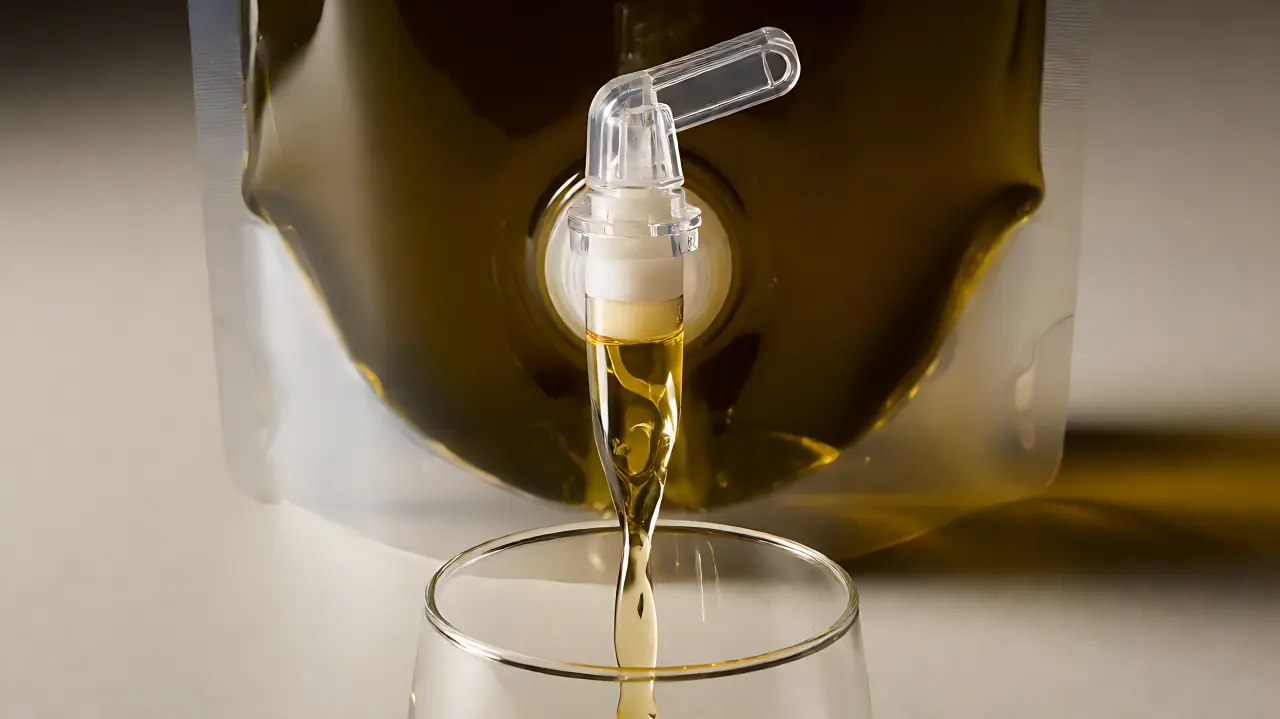
Bag-in-Box Dispensing Taps: Vitop vs. FlexTap Guide
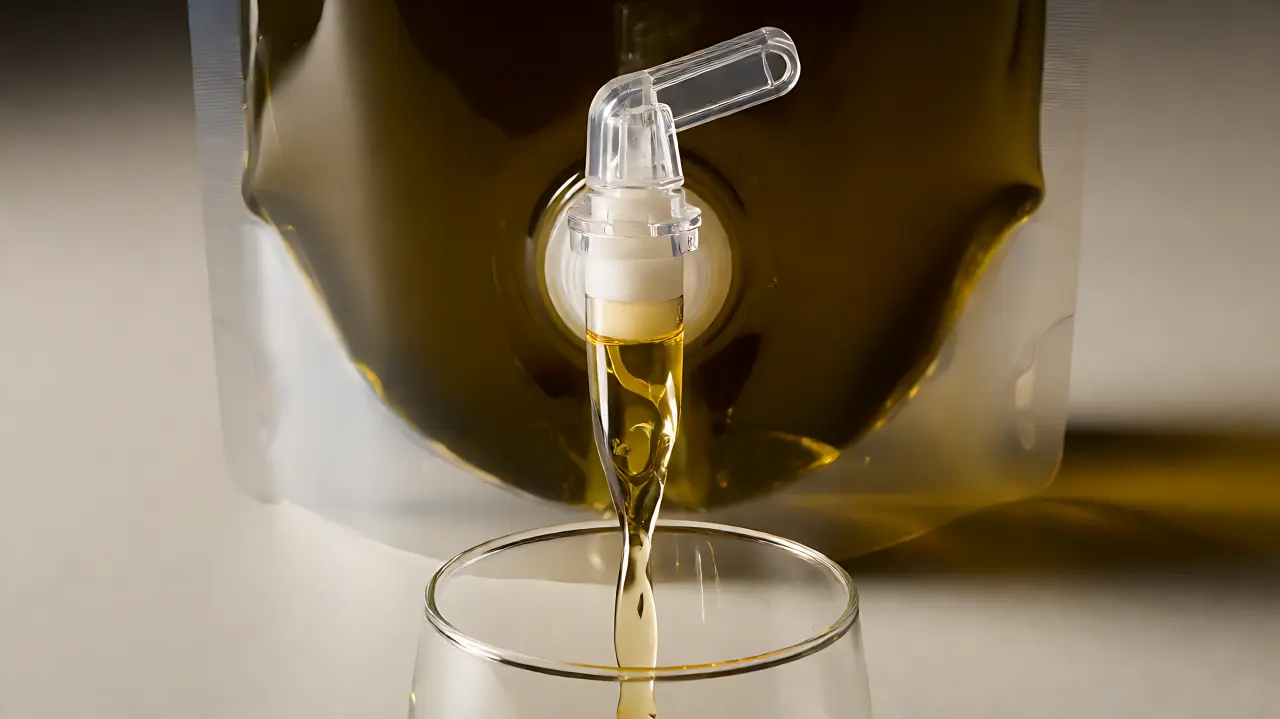
In liquid flexible packaging—spanning commercial premium wines, cold-pressed olive oils, liquid egg formulations, cold brew coffee concentrates, and post-mix beverage syrups—the Bag-in-Box (BIB) and Spouted Barrier Pouch format is the gold standard for bulk liquid distribution. By allowing multi-layer flexible barrier pouches to collapse under atmospheric pressure as liquid dispenses, the BIB system prevents air from entering the package headspace, preserving sensitive liquids for up to 6 to 8 weeks after opening.
However, the barrier performance and user experience of a Bag-in-Box system is fundamentally dictated by its weakest physical link: the dispensing tap closure.
While the flexible bag film may achieve near-zero gas permeability via EVOH or aluminum foil, atmospheric oxygen can penetrate through the microscopic seals of an inferior tap body. Furthermore, valve weeping, dripping, and high opening actuation forces frustrate consumers and commercial baristas.
This technical guide delivers an engineering evaluation of Bag-in-Box Dispensing Taps, comparing the industry-standard Vitop Original Tap, FlexTap (Gravity Valve), and Traditional Twist Lever Taps, analyzing oxygen ingress rates (OTR), elastomer valve seal physics, flow rates, and high-speed automated fitment insertion.
1. Technical Matrix: Bag-in-Box Dispensing Tap Comparison
| Engineering Metric | Vitop Original Press Tap | FlexTap Push-Button Valve | Rotary Lever / Turn Tap | Top-Mounted Pour Spout (Screw Cap) |
|---|---|---|---|---|
| Dispensing Mechanism | Dual lateral side-wing press levers | Top thumb push-button spring valve | 90° to 180° rotary lever handle | Unscrew threaded rigid cap & pour |
| Valve Resealing Type | Elastomer diaphragm with internal spring | Silicone poppet valve with coil | Mechanical friction cone plug | Manual cap retightening |
| Oxygen Ingress Rate (OTR) | $< 0.1\text{ cc O}_2\text{ / tap / year (Ultra-Low)}$ | $< 0.15\text{ cc O}_2\text{ / tap / year}$ | $0.5\text{ to }1.2\text{ cc O}_2\text{ / tap / yr}$ | Atmospheric air floods in upon opening |
| Dispensing Flow Rate (Wine/Water) | $> 50\text{ ml / second (Fast & smooth)}$ | $35\text{ to }45\text{ ml / second}$ | $25\text{ to }35\text{ ml / second}$ | Gravity glug flow (Unregulated) |
| Drip Prevention / Anti-Weep | Zero Drip (Snap-back instantaneous shutoff) | Clean shutoff | Occasional post-pour drip | Pour lip drips on pouch body |
| Environmental Stress Cracking (ESCR) | Immune (POM / PP chemical resistant) | High (Polyethylene body) | Moderate | High |
| Tamper-Evident Security | Integrated tear-strip tamper band | Tear-off protective cap cover | Snap-away plastic ring | Break-away ratchet collar ring |
| Automated Insertion Speed | Up to 45 to 60 taps/minute (Rotary lines) | Up to 35 to 45 taps/minute | 20 to 30 taps/minute | 30 to 45 caps/minute |
| Cost Index per Tap Fitment | Baseline (1.0× — Global Benchmark) | 0.90× to 1.05× Baseline | 0.80× to 0.90× Baseline | 0.65× to 0.75× Baseline |
To explore our high-barrier liquid pouches, aseptic liners, and BIB packaging systems, visit our Stand-up Pouches Category.
2. Valve Sealing Mechanics & Oxygen Ingress (OTR) Physics
In wine and cold brew coffee packaging, dissolved oxygen is the primary cause of oxidation, converting ethanol to acetaldehyde and browning polyphenols. Because Bag-in-Box wines sit on retail shelves for 6 to 12 months prior to purchase, the tap’s unopened oxygen transmission rate is paramount:
Cross-Sectional Architecture of Vitop Dispensing Tap:
┌────────────────────────────────────────────────────────┐
│  Tamper-Evident Tear Band (Protects Sanitary Spout)    │
├────────────────────────────────────────────────────────┤
│  Dispensing Orifice with Anti-Drip Beveled Lip         │
├────────────────────────────────────────────────────────┤
│  Precision Injection-Molded POM Body (Polyoxymethylene)│
│  ┌──────────────────────────────────────────────────┐  │
│  │  Elastomer Diaphragm / Valve Piston              │  │ <── Gas-tight seat prevents
│  │  ░░░░░░░░░░░░░░░░░░░░░░░░░░░░░░░░░░░░░░░░░░░░░   │  │     molecular oxygen diffusion
│  │  Integrated Stainless Steel / Polymeric Spring   │  │ <── Snaps shut in <0.02 seconds
│  └──────────────────────────────────────────────────┘  │
├────────────────────────────────────────────────────────┤
│  32mm HDPE Flange / Gland (Heat-Welded to Barrier Pouch│
└────────────────────────────────────────────────────────┘-
The Oxygen Permeation Route:
- In low-grade rotary lever taps, atmospheric oxygen diffuses through the plastic clearance gap between the moving barrel and the tap housing.
- The Vitop Original Tap utilizes a precision-molded internal piston surrounded by a specialized elastomer diaphragm. The diaphragm creates a continuous, hermetic interference seal against the tap body that blocks oxygen molecules ($O_2$) from permeating inward, maintaining an annual oxygen transmission rate below $0.1\text{ cc of } O_2\text{ per tap per year}$.
-
Self-Closing Anti-Drip Kinematics:
- When a consumer releases the two ergonomic side wings of a Vitop tap, an internal mechanical spring snaps the valve piston back against its seat in $< 20\text{ milliseconds}$.
- The instantaneous cut-off breaks the liquid capillary meniscus cleanly, completely eliminating post-pour drips that could stain restaurant countertops or carton packaging.
3. Chemical Resistance & Environmental Stress Cracking (ESCR)
Liquid packaging closures encounter chemically aggressive liquids under prolonged hydrostatic head pressure:
- Ethanol & Solvent Stress Cracking: Alcoholic beverages (12% to 15% ABV wines; 40% ABV spirits) and citrus syrups containing d-limonene act as plasticizers on lower-grade polyethylene polymers. Under mechanical residual molding stress, low-grade taps develop micro-cracks (Environmental Stress Cracking, or ESCR) along hinge flex points within 60 days, leading to catastrophic liquid weeping.
- Polyoxymethylene (POM) Engineering: Premium tap bodies are injection-molded from high-crystallinity POM (Polyoxymethylene / Acetal copolymer) or specialized high-density polyethylene (HDPE) compounds certified for zero environmental stress cracking across 100% pure alcohol, vinegar acetic acid, and vegetable lipids.
4. Bag Gland Ultrasonic Welding & High-Speed Insertion
The mechanical integration of the dispensing tap onto the flexible barrier pouch is performed during bag converting:
Fitment Gland Ultrasonic Sealing Sequence:
1. Pouch Hole Punch ──► 2. 32mm Gland Position ──► 3. Ultrasonic Plunge Horn ──► 4. Tap Insertion
┌──────────────┐        ┌──────────────────┐       ┌───────────────────────┐    ┌─────────────┐
│ 28mm hole cut│        │ 32mm HDPE boat   │       │ 20 kHz ultrasonic horn│    │ Mechanical  │
│ in barrier   │───────►│ gland placed     │──────►│ welds flange to film  │───►│ tap pushed  │
│ pouch film   │        │ under web hole   │       │ in 400 milliseconds   │    │ into gland  │
└──────────────┘ └──────────────────┘ └───────────────────────┘ └─────────────┘- The 32mm Gland Weld:
- The flexible barrier pouch is pre-punched with a precision hole. A 32mm diameter polyethylene gland (fitment collar) is positioned underneath.
- High-energy 20 kHz ultrasonic plunge horns seal the circular flange of the gland to the inner PE sealant layer of the multi-layer barrier film (
PET / EVOH / PEorMET-PET / PE). Ultrasonic energy creates localized molecular friction, welding the joint in 400 milliseconds without scorching the outer barrier film.
- Post-Fill Tap Insertion:
- On automated Bag-in-Box filling lines (such as Smurfit Kappa or Scholle IPN machines), the pouch is filled with liquid through the open gland aperture at high speed.
- Immediately following nitrogen capping, a pneumatic ram pushes the dispensing tap into the gland, engaging dual locking security ridges that form an irreversible, leak-proof mechanical detent.
5. Strategic Liquid Dispensing Selection Blueprint
                      What liquid product is being packaged in bulk?
                                     │
                     ┌───────────────┴───────────────┐
           Oxygen-Sensitive Premium Liquids             High-Viscosity Oils / Syrups
             (Wine, Cold Brew Coffee, Cider)             (Edible Oils, Sauces, Detergents)
                     │                               │
        Does the product require extended post-   Do consumers require continuous
         opening freshness (> 4 to 6 weeks)?       high-volume liquid flow (>60ml/s)?
                     │                               │
        ┌────────────┴────────────┐             ┌────┴──────────────────────────┐
       YES                        NO            │ Deploy Large-Bore Pour Spout  │
        │                          │            │ or FlexTap High-Flow Valve:   │
  Deploy Vitop Original Tap:       │            │ - Foodservice cooking oils    │
  - OTR < 0.1 cc/tap/year          │            │ - Liquid laundry detergent    │
  - Zero-drip snap shutoff         │            │ - Post-mix beverage syrups    │
  - 100% tamper-evident band       │            └───────────────────────────────┘
  - 6 to 8 weeks post-open life    │
  - Global consumer recognition    └──────────> Deploy Standard Rotary Lever Tap
                                                for Short-Turnover Institutional Drinks
CraftPack Global engineers customized Bag-in-Box barrier pouches, metallized liquid liners, and spouted pouch fitments tested under ASTM F1140 burst and ASTM D5276 drop protocols.
Consult our liquid packaging engineering team to configure complete dispensing solutions via our Stand-up Pouches & Liquid Division.