
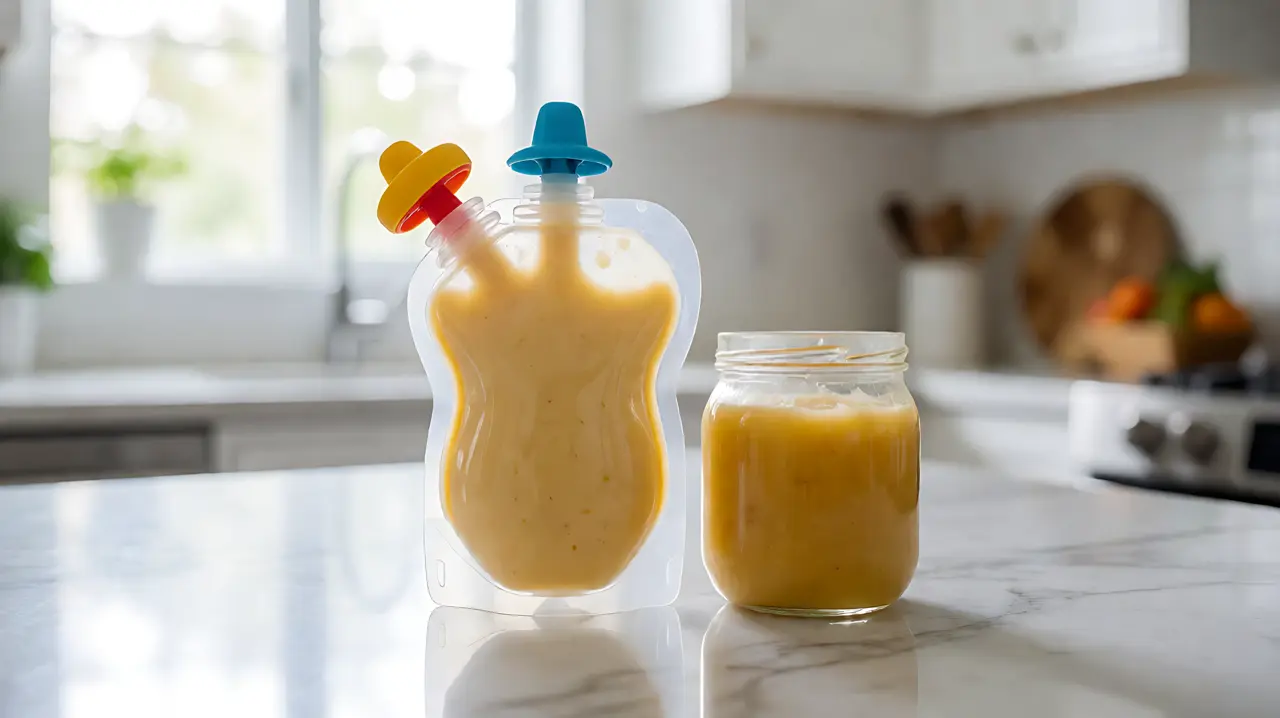
Spouted Pouches vs Glass for Baby Food: Safety Guide
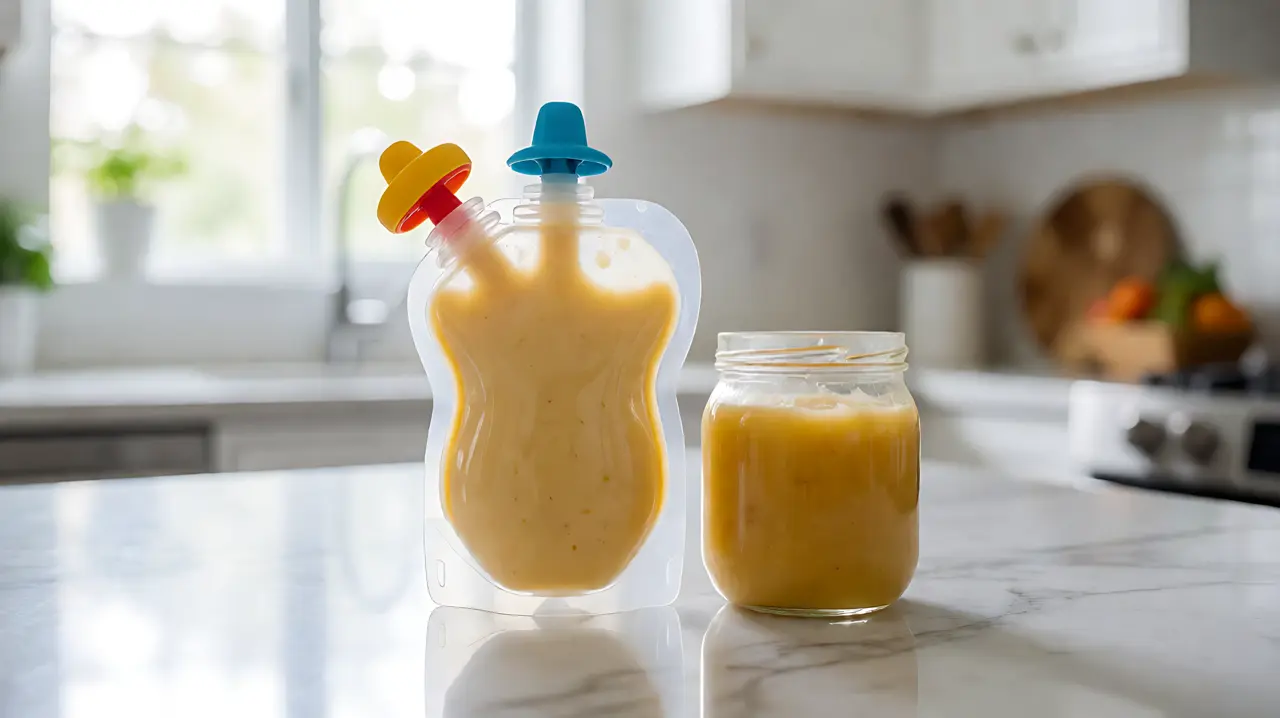
In the infant nutrition and baby food puree market, the container format does not merely package the food—it directly impacts child safety, feeding ergonomics, and parent brand loyalty. For decades, the small vacuum-sealed glass jar (typically 110g to 190g) with a metal twist-off lug cap served as the clinical standard of purity and microbiological safety.
However, over the past decade, flexible spouted pouches have captured more than 75% of the global baby food puree segment. Pouches eliminate the risk of shattered glass in diaper bags and nurseries, allow toddlers to self-feed via direct squeezing, and offer up to an 85% reduction in packaging tare weight.
Yet manufacturing flexible baby food packaging introduces stringent engineering hurdles: the pouches must survive intensive retort thermal sterilization (121°C) or aseptic cold filling, utilize certified choke-safe anti-choke caps, and eliminate all endocrine-disrupting chemical migrants.
This technical guide compares flexible spouted pouches against traditional glass jars across sterilization physics, anti-choke cap safety (BS 7272 / ISO 8124), chemical migration testing, and logistics carbon accounting.
1. Technical Comparison: Spouted Pouches vs. Glass Jars for Infant Nutrition
| Engineering Metric | Multi-Layer Retort Spouted Pouch | Traditional Glass Jar with Metal Cap | Monolayer Plastic Tub with Foil Lid |
|---|---|---|---|
| Tare Weight (Per 100g Food) | ~8 g to 10 g (Ultra-lightweight) | ~110 g to 140 g (Heavy packaging bulk) | ~15 g to 20 g |
| Packaging-to-Product Weight Ratio | ~8% Packaging : 92% Food | ~55% Packaging : 45% Food | ~15% Packaging : 85% Food |
| Drop & Shatter Risk | Zero shatter risk (Absorbs drop impact) | High shatter hazard; creates sharp glass shards | Low shatter risk |
| Feeding Ergonomics | Direct squeeze self-feeding; no spoon needed | Requires separate spoon and feeding dish | Requires separate spoon |
| Choking Hazard Prevention | Mandatory Large-Diameter Anti-Choke Cap | Small metal lid; safe when closed | Peel-off foil can present small parts |
| Sterilization Technology | Retort Autoclave (121°C) or Aseptic Hot Fill | Thermal Retort Processing (121°C) | Hot fill or aseptic |
| Chemical Safety / Migration | Certified BPA-free, phthalate-free, non-PVC | Pristine inert glass; PVC gasket concerns | Polypropylene contact layer |
| Ocean & Truck Freight Density | High (Empty pouches ship flat; minimal space) | Very low (Empty jars occupy 100% volume) | Moderate (Nestable cups) |
| Carbon Footprint (LCA) | ~60% to 70% lower lifecycle CO₂ | Baseline (High energy in glass melting) | Moderate carbon profile |
For specialized consumer liquid packaging and fitment options, browse our Stand-Up Pouches Category and spouted packaging options.
2. Sterilization Engineering: Retort Pouches vs. Aseptic Hot Fill
Baby purees—encompassing fruits, vegetables, and meat broths—are low-acid foods (pH > 4.5) susceptible to Clostridium botulinum spore germination unless sterilized to a lethality value ($F_0 \ge 3.0$):
Thermal Sterilization Dynamics:
Glass Jar (Thermal Insulator):               Flexible Retort Pouch (Thin Profile):
┌─────────────────────────┐                 ┌───────┐
│ Slow Heat Penetration   │                 │ Fast  │ Rapid Thermal Conduction
│ Cold Core: 35-45 mins   │                 │ Heat  │ Cold Core Reached in 12-18 mins
│ Thermal Degradation of  │                 │ Inflow│ Minimal Heat Stress
│ Vitamins & Fruit Colors │                 │       │ Fresh Flavor & Nutrients Kept
└─────────────────────────┘ └───────┘- The Thick Glass Conduction Bottleneck: Glass has very low thermal conductivity ($k \approx 0.8\text{ W/m}\cdot\text{K}$). To heat the cold center point of a glass jar to 121°C, the jar must dwell in a pressurized steam retort for 35 to 45 minutes. This prolonged heat exposure cooks out delicate fruit vitamins (Vitamin C degradation > 40%) and alters fresh fruit colors to a dull brown.
- The Slim Pouch Thermal Advantage: A flexible stand-up pouch has a thin cross-sectional thickness (typically 20mm to 30mm when filled). High-pressure steam transmits heat into the core within 12 to 18 minutes. This 50%+ reduction in thermal exposure preserves natural fruit sweetness, vibrant pigments (carotenoids and anthocyanins), and heat-sensitive micronutrients.
3. Anti-Choke Cap Engineering (BS 7272 & ISO 8124 Compliance)
The most visible safety feature of any baby food pouch is the oversized plastic cap. Small children frequently place bottle caps into their mouths, creating severe tracheal asphyxiation risks:
Anti-Choke Safety Cap Architecture:
        ┌───────────────────────┐
        │  Wide Diameter (>33mm) │  <-- Exceeds Infant Pharyngeal Gauge
        │  ┌───┐  ▲   ▲  ┌───┐  │
        │  │   │  │   │  │   │  │
        │  └───┘  │   │  └───┘  │  <-- Built-in Continuous Airway Vents
        └─────────┴───┴─────────┘
1. The Large-Diameter Threshold (>33mm)
Standard beverage caps measure 28mm in diameter, fitting easily inside the standardized small parts test cylinder (ASTM F963 / 16 CFR 1501). Baby food caps feature wide flared outer rims measuring $\ge 33\text{ mm to }38\text{ mm}$ across, making it physically impossible for an infant or toddler to swallow or inhale the cap into the airway.
2. Continuous Airway Vents (BS 7272)
Even if an older child manages to wedge the cap into their mouth, international safety standards (BS 7272 and ISO 8124-1) mandate open-flow airway venting. The cap body incorporates vertical bypass channels that allow an air flow rate of at least 8 Liters per minute at a differential pressure of 1.33 kPa, ensuring the child can breathe until medical assistance arrives.
3. Tamper-Evident Tear Ring
The cap connects to a ratchet collar via calibrated break-away bridges. Opening the cap requires a minimum torque of 1.2 to 2.0 N·m, leaving an unmistakable severed ring attached to the spout neck.
4. Substrate Laminate Selection: Retort Foil vs. Transparent Barrier
Baby food pouch laminations must resist thermal delamination and acidic fruit degradation:
1. Four-Layer Aluminum Foil Structure (High-Retort Shelf Life 18–24 Months)
BOPET 12µm / BOPA (Nylon) 15µm / AL Foil 9µm / Retort-CPP 70µm- Zero OTR / WVTR: Total light and gas barrier eliminates photo-oxidation, preserving purees for two years at room temperature without synthetic preservatives.
- BOPA Shock Layer: The biaxially oriented polyamide layer cushions the brittle aluminum foil, preventing Gelbo micro-pinholing during shipping.
2. Non-Foil Transparent High-Barrier (Microwave-Safe & Metal Detector Ready)
BOPET 12µm AlOx / BOPA 15µm / Retort-CPP 60µm- Provides crystal-clear puree visibility while maintaining an OTR $< 1.0\text{ cc/m}^2/\text{day}$, allowing online X-ray and metal inspection systems to scan finished pouches.
5. Chemical Safety & Strict Migration Limits
Because infants have developing metabolic systems and higher relative food intake per body weight, regulatory migration thresholds are vastly stricter than adult food packaging:
- Zero BPA, BPS, & Phthalates: Polypropylene spouts and CPP inner sealant films are 100% bisphenol-free and phthalate-free, formulated without plasticizers.
- Primary Aromatic Amines (PAA): Multi-layer laminates must use specialized aliphatic or aromatic polyether-polyurethane retort adhesives, guaranteeing overall PAA migration remains strictly undetectable below 0.01 mg/kg food (10 ppb) per EU Regulation 10/2011.
- Heavy Metals & NIAS: Independent screening confirms zero Non-Intentionally Added Substances (NIAS) or heavy metal catalysts in the food-contact layer.
6. Infant Food Brand Procurement & Quality Checklist
When contracting flexible spouted pouch production for infant purees, verify:
- Cap Safety Certification: Obtain third-party mechanical test reports verifying compliance with BS 7272 and ISO 8124 for anti-choke cap geometry.
- Retort Burst and Seal Strength: Mandate post-autoclave tensile seal strength $\ge 35\text{ N/15mm}$ (ASTM F88) and pouch burst resistance $\ge 0.45\text{ bar}$ (ASTM F1140).
- Spout Weld Hermeticity: Require ultrasonic or thermal flange leak testing confirming zero capillary bypass along the boat-shaped spout weld.
- Drop Survivability: Verify filled pouches withstand 1.8-meter drops onto flat concrete at ambient and refrigerated (4°C) temperatures without bursting.
To engineer certified retort spouted pouches with anti-choke safety closures for your infant nutrition brand, connect with the CraftPack Global technical packaging group.