
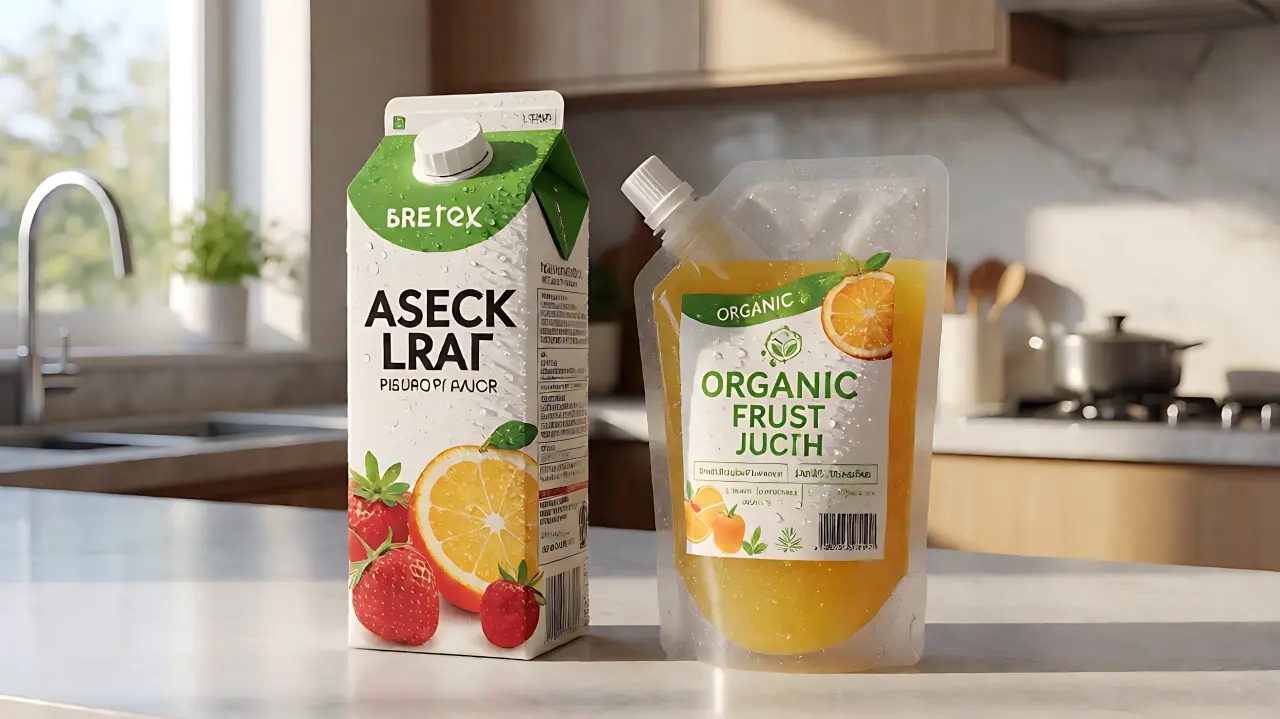
Aseptic Brick Cartons vs Spouted Pouches: Liquid Food Guide
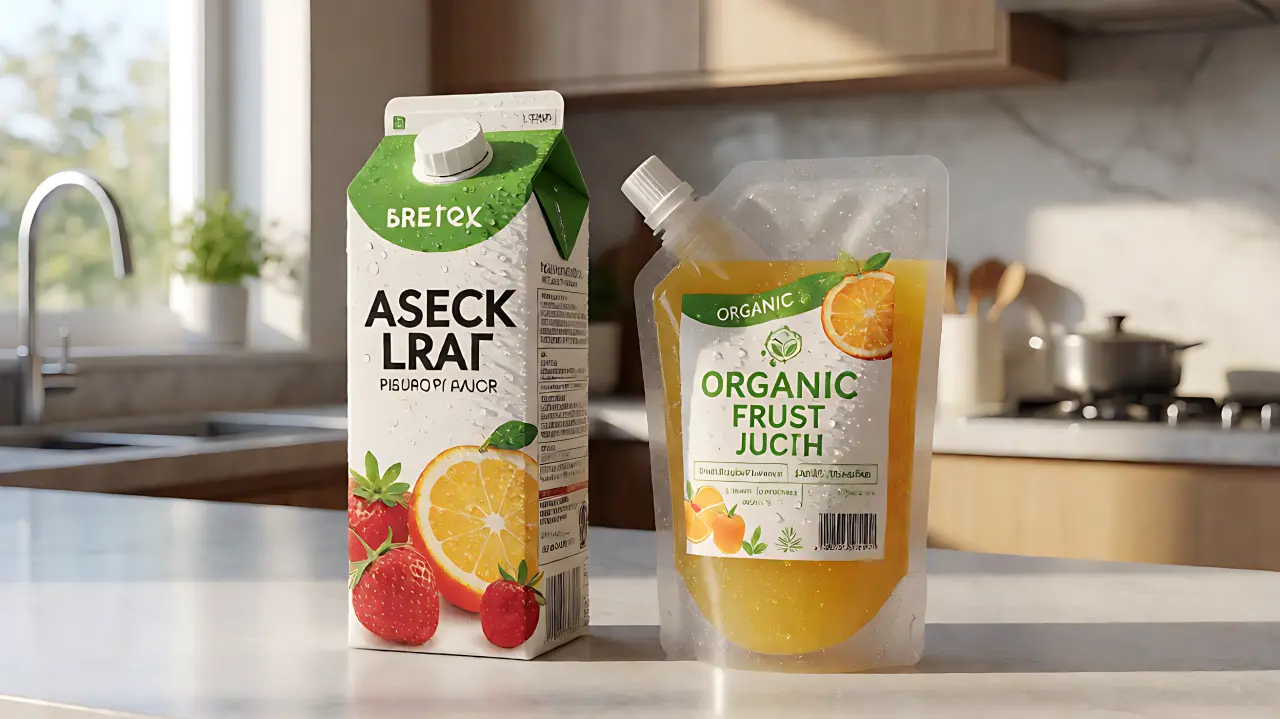
In shelf-stable ambient liquid food packaging—including plant-based milks, cold-pressed juices, pureed fruit sauces, and culinary broths—extended shelf life ($12\text{ to }18\text{ months}$) without chemical preservatives requires commercial sterility. Thermal pasteurization or Ultra-High Temperature (UHT) sterilization must be paired with hermetic, pinhole-free oxygen and light barrier packaging.
Brand managers and packaging engineers frequently benchmark established Aseptic Brick Composite Cartons (roll-fed multi-ply paperboard) against innovative Pre-Formed Stand-Up Spouted Pouches.
Barrier Cross-Section & Laminate Engineering
Aseptic Brick Carton (6-Layer Composite)     Stand-Up Spouted Pouch (4-Layer Barrier)
┌──────────────────────────────────────┐     ┌──────────────────────────────────────┐
│ Polyethylene Outermost (14 µm, gloss)│     │ Print Substrate: Biaxially PET (12µm)│
├──────────────────────────────────────┤     ├──────────────────────────────────────┤
│ Bleached Paperboard (70% total wt)   │     │ Gas Barrier Core: Al Foil or AlOx    │
├──────────────────────────────────────┤     ├──────────────────────────────────────┤
│ Laminating Polyethylene (Tie layer)  │     │ Mechanical Backbone: BOPA Nylon(15µm)│
├──────────────────────────────────────┤     ├──────────────────────────────────────┤
│ Solid Aluminum Foil (6.3 µm barrier) │     │ Sealant & Food Contact: mLLDPE/CPP   │
├──────────────────────────────────────┤     └──────────────────────────────────────┘
│ Adhesive Copolymer Tie Layer         │                        ▼
├──────────────────────────────────────┤      Ultrasonic or Thermal Weld to Injection-
│ Internal Food-Contact PE (40-50 µm)  │      Molded HDPE Spout Fitment (8-16 mm Ø).
└──────────────────────────────────────┘
1. Aseptic Brick Cartons (Roll-Fed FFS)
- Material Composition: Approximately $70%$ virgin wood fiber paperboard (providing structural rigidity), $24%$ low-density polyethylene (internal/external waterproofing), and $6%$ ultra-thin aluminum foil ($6.3,\mu\text{m}$, blocking $100%$ of UV light and oxygen).
- Filling Process: Formed, filled, and sealed continuously from rollstock inside a sterile chamber sterilized with vaporized or liquid hydrogen peroxide ($H_2O_2$ at $70^\circ\text{C}$). The web forms a continuous tube filled below the liquid meniscus, completely eliminating air headspace.
2. Stand-Up Spouted Barrier Pouches
- Material Composition: Fully synthetic or mono-material barrier laminates (e.g., PET / Al Foil / BOPA / PE or modern recyclable MDO-PE / EVOH / PE).
- Spout Architecture: An injection-molded polyethylene spout fitment (Ø $8.6\text{mm} - 16\text{mm}$) is hermetically welded into the pouch top gusset via multi-stage heated brass sealing jaws or ultrasonic welding ($20\text{ kHz}$).
- Consumer Usability: Resealable twist-cap, highly tactile, lightweight, and completely shatterproof. Excellent ergonomic control for on-the-go snacking and direct-from-pack consumption by children.
For further technical insights on liquid fitment engineering, review our spout fitment closures guide and aseptic pouches vs glass containers.
Technical Performance Matrix
| Engineering Metric | Aseptic Brick Composite Carton | Stand-Up Spouted Barrier Pouch | Testing Standard |
|---|---|---|---|
| Empty Package Tare Weight | $\approx 26 - 32\text{ g}$ (per 1L pack) | $\approx 12 - 16\text{ g}$ (per 1L pack) | Digital Scale Analysis |
| Pallet Cube Space Utilization | $90% - 94%$ (Near-perfect brick) | $76% - 82%$ (Gusset voids) | Palletization Audit |
| Drop Impact Survivability | Moderate ($1.2\text{ m}$ limit, corner risk) | High ($> 2.0\text{ m}$ drop survival) | ASTM D5276 |
| Filling Line Capital Cost (CapEx) | Very High ($$1.5\text{M} - $4.0\text{M}$) | Moderate ($$180\text{k} - $500\text{k}$) | Equipment Benchmark |
| Pinhole Resistance (Gelbo Flex) | High (Supported by stiff board) | High (BOPA nylon reinforced) | ASTM F392 |
| Resealability Performance | Screw-cap on carton / peel foil | Precision threaded choke-resistant cap | BS 7272 Compliance |
| Post-Consumer Recycling | Specialist hydro-pulping required | Mono-PE circular streams available | APR / CEPI Guidelines |
Cube Efficiency vs. Freight Weight Trade-Offs
The choice between brick cartons and spouted pouches involves a direct conflict between volumetric cube space and packaging tare weight:
$$\text{Payload Efficiency} = \frac{\text{Net Mass of Liquid Product}}{\text{Gross Shipping Mass (Product + Packaging + Corrugate)}}$$
- The Pallet Cube Advantage of Brick Cartons:
- Because brick cartons possess flat rectangular 90-degree faces, they nest with zero dead air space on standard EUR ($1200 \times 800\text{ mm}$) and GMA ($48 \times 40\text{ in}$) shipping pallets.
- A single standard pallet can carry up to 750 liters of liquid in brick cartons, maximizing road and ocean freight volumetric limits ($> 92%$ cube efficiency).
- The Tare Weight & Ergonomic Advantage of Spouted Pouches:
- Spouted pouches weigh up to $50%$ less than composite paperboard cartons and up to $95%$ less than rigid glass jars.
- For e-commerce parcel shipping, spouted pouches absorb handling drop shocks without corner crushing or weeping leaks, eliminating secondary bubble mailer protective wrap.
Recycling Infrastructure & Circularity (PPWR Compliance)
- Carton Recycling: Aseptic paperboard cartons require specialized hydropulping mills to separate the cellulose fibers from the tightly bound PolyAl (polyethylene and aluminum foil mix). While pulp recovery yields high-quality brown paperboard, recycling access varies by regional municipal infrastructure.
- Mono-Material Pouches: Under the European Union Packaging and Packaging Waste Regulation (PPWR), CraftPack Global now engineers All-PE (MDO-PE / EVOH / PE) spouted pouches with PE fitments and caps. These deliver an $O_2$ transmission rate $< 0.1\text{ cc}/(\text{m}^2 \cdot 24\text{h})$ while classifying as $100%$ recyclable mono-material polyolefin streams (RIC 4).
Discover our full range of flexible stand-up pouches and heavy-duty bag-in-box dispensing solutions. Contact CraftPack Global to engineer customized barrier structures and spout geometries for your liquid beverage lines.