
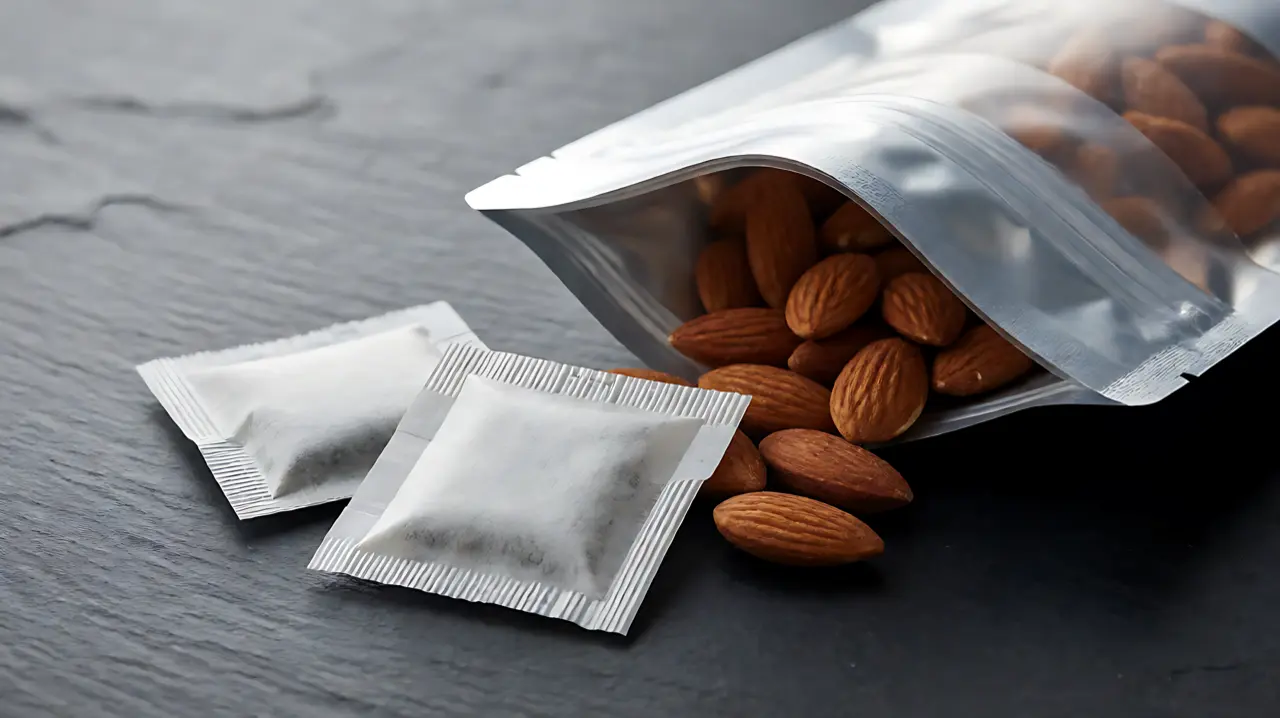
Active Packaging: Oxygen Absorbers & Moisture Scavengers Guide
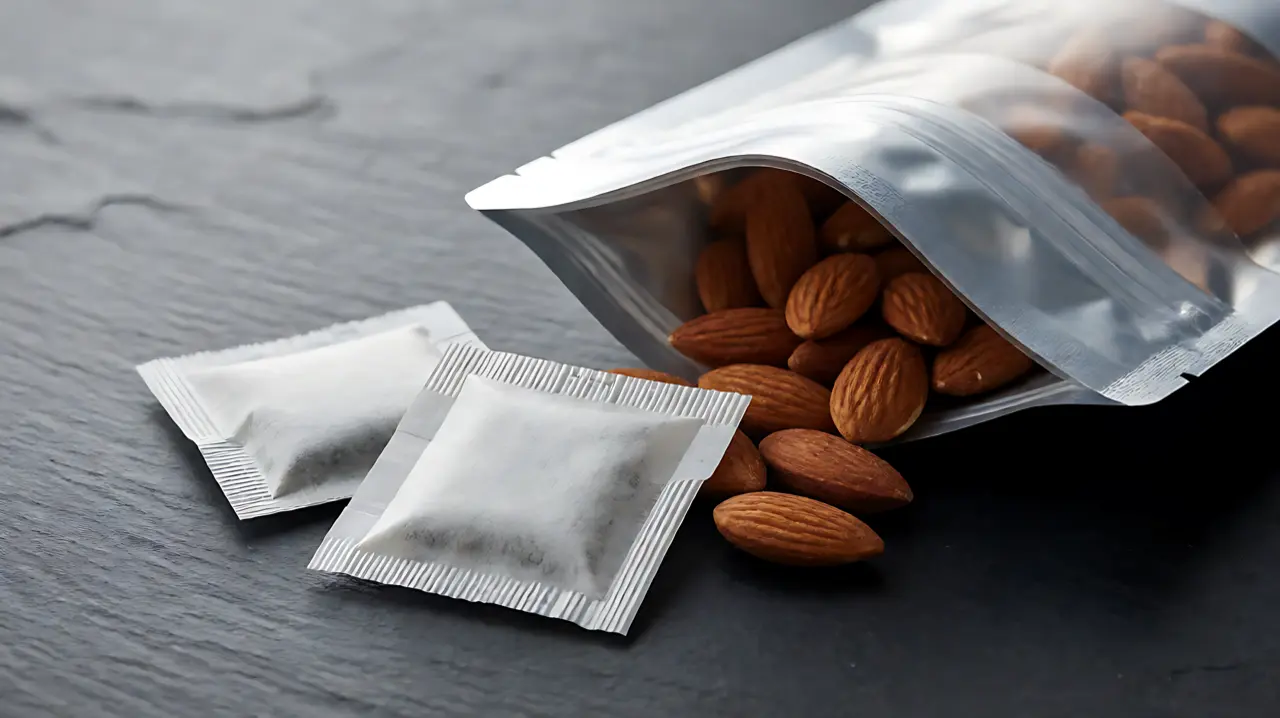
In modern food preservation, barrier packaging films (such as metallized PET, EVOH, and aluminum foil) act as passive defenses: they slow down the permeation of ambient oxygen and water vapor into the package. However, passive barriers cannot remove the residual oxygen trapped inside the pouch headspace at the moment of sealing (which typically contains 20.9% O₂ unless vacuumed or nitrogen-flushed).
Even with vacuum packaging or modified atmosphere packaging (MAP), industrial filling machinery typically leaves a residual oxygen concentration between 0.5% and 2.0%. For highly sensitive shelf-stable foods—including roasted nuts, beef jerky, pet treats, dehydrated pharmaceuticals, and specialty baked goods—this trace oxygen is more than sufficient to trigger lipid auto-oxidation, enzymatic browning, rancid off-flavors, and aerobic mold proliferation.
Active packaging bridges this critical gap. Rather than acting as a static barrier, active scavenging components chemically capture trapped oxygen and moisture, driving internal headspace oxygen levels down below 0.01% (less than 100 ppm) within 24 to 48 hours.
This guide details the chemical formulations, volumetric sizing calculations, pouch material requirements, and food safety standards for specifying oxygen absorbers and desiccants.
1. Engineering Comparison: Scavenger Chemistry & Sachet Matrix
| Scavenger Type | Chemical Mechanism | Reaction Kinetics | Target Atmosphere | Primary Food Applications | Key Limitations |
|---|---|---|---|---|---|
| Ferrous Iron Scavenger (Standard) | $4\text{Fe} + 3\text{O}_2 + 6\text{H}_2\text{O} \rightarrow 4\text{Fe(OH)}_3$ | Fast (O₂ < 0.01% in 24–48h) | Requires water activity ($a_w > 0.50$) | Beef jerky, mooncakes, pet treats, baked pastries | Tripped by metal detectors; produces minor exothermic heat |
| Self-Activating Iron Scavenger | Contains internal moisture-releasing salts | Moderate (24–72h) | Dry goods ($a_w < 0.30$) | Powdered milk, spices, coffee beans, dehydrated fruits | Slightly higher sachet bulk volume |
| Non-Iron / Organic Scavenger | Ascorbic acid / Polyunsaturated oligomer oxidation | Slower (48–96h) | High and low moisture goods | Metal-detector compatible foods, pharmaceutical tablets | Higher unit cost (2x to 3x iron sachets) |
| Silica Gel Desiccant | Physical physisorption in nanometer pores ($SiO_2$) | Rapid moisture capture | Humidity control | Crispy snacks, cookies, seaweed, electronics | Can desorb moisture at elevated temperatures (>50°C) |
| Montmorillonite Bentonite Clay | Layered aluminosilicate natural clay absorption | Steady, uniform absorption | Relative humidity $10% - 60%$ | Organic pet kibble, dehydrated agricultural seeds | Lower maximum saturation capacity than silica gel |
For compatible barrier films that preserve scavenger capacity, browse our Stand-Up Pouches Category and Flat Bottom Bags.
2. Engineering Math: Calculating Oxygen Absorber Capacity (cc O₂)
Specifying the wrong oxygen absorber size leads to premature oxidation if undersized, or wasted budget and potential pouch panel implosion if oversized. Follow this standard packaging engineering formula:
Step 1: Calculate Total Package Volume (V_total in mL)
Step 2: Subtract Food Mass Volume (V_food = Net Weight in grams / Food Density in g/mL)
Step 3: Headspace Volume (V_headspace) = V_total - V_food
Step 4: Calculate Trapped Atmospheric Oxygen Volume:
        Initial O₂ Volume (mL) = V_headspace × 0.209 (for atmospheric air)
Step 5: Account for Film Permeation During Target Shelf Life:
        Permeated O₂ (mL) = Pouch Surface Area (m²) × Film OTR (cc/m²/day) × Shelf Life (days)
Step 6: Total Required Absorber Rating = (Initial O₂ + Permeated O₂) × Safety Factor (1.2 to 1.5)
Engineering Example: Roasted Macadamia Nuts
- Pouch Dimension: 160 mm × 240 mm stand-up pouch (Total surface area $\approx 0.08\text{ m}^2$).
- Pouch Internal Volume: 850 mL.
- Product Weight & Density: 250 g of nuts with bulk density $0.60\text{ g/mL}$ $\rightarrow V_{\text{food}} = 416\text{ mL}$.
- Headspace Volume: $850\text{ mL} - 416\text{ mL} = 434\text{ mL}$.
- Initial Trapped O₂: $434\text{ mL} \times 0.209 = 90.7\text{ mL (cc)}$.
- Target Shelf Life: 365 days in a Met-PET pouch with OTR $= 1.0\text{ cc/m}^2/\text{day}$.
- Oxygen Permeated Over 1 Year: $0.08\text{ m}^2 \times 1.0 \times 365 = 29.2\text{ cc}$.
- Total Oxygen Challenge: $90.7\text{ cc} + 29.2\text{ cc} = 119.9\text{ cc}$.
- Specification with 1.3x Safety Factor: $119.9 \times 1.3 = \mathbf{156\text{ cc}}$.
- Recommended Specification: A standard 200 cc or 160 cc commercial oxygen absorber sachet.
3. Pouch Barrier Requirements for Scavenger Efficacy
An oxygen absorber cannot compensate for a high-permeability packaging film. If oxygen penetrates the flexible pouch faster than the chemical scavenger can react, internal O₂ levels will never drop below the microbial growth threshold:
- Permeability Ceiling: For active packaging to maintain shelf stability beyond 6 months, the barrier pouch film must feature an Oxygen Transmission Rate (OTR) of $\le 2.0\text{ cc/m}^2/\text{day}$ at 23°C / 65% RH. Standard LDPE or untreated CPP films (OTR > 1,000 cc/m²/day) will exhaust the scavenger within days.
- Recommended Substrate Laminations:
BOPP 20µm / VM-PET 12µm / LLDPE 60µm(OTR: 0.8–1.5 cc/m²/day)PET 12µm / AL Foil 7µm / LLDPE 70µm(OTR: < 0.1 cc/m²/day — Hermetic Zero Barrier)BOPET 12µm / EVOH Coex 15µm / PE 50µm(OTR: 0.5–1.2 cc/m²/day — Transparent Recyclable)
- Hermetic Seal Quality: Capillary leaks in top seals, zipper terminations, or gusset intersections immediately bypass the barrier film. Thermosealing must be validated via ASTM F88 peel testing (>25 N/15mm) and ASTM D3078 bubble emission leak tests.
4. Operational Handling: Preventing Premature Sachet Depletion
Oxygen absorbers are packaged under vacuum in bulk master packs (typically 100 to 250 units per master bag). Plant operating procedures must enforce strict exposure limits:
Sachet Handling Protocol on Packaging Line:
[Open Master Bag] ──> [Dispense 30-Minute Working Tray] ──> [Seal Products Immediately]
       │
└─── Remaining Master Stock ──> [Vacuum Seal or Nitrogen Flush within 15 Minutes]- Open Time Window: Standard iron-based absorbers begin reacting within 10 to 15 minutes of atmospheric contact. Line operators must never leave open sachets exposed to ambient air for more than 30 to 45 minutes.
- Vacuum Resealing: Any unused sachets at the end of a production shift must be immediately returned to high-barrier foil bags, vacuumed, and impulse-sealed to preserve residual scavenging capacity.
- Oxygen Indicator Eyes: Premium master bags feature a reversible pink/blue tablet. Pink indicates an oxygen-free environment (<0.1% O₂); if the tablet turns purple or blue, the master pack has been compromised and must be quarantined.
5. Food Contact Safety & Regulatory Standards
- FDA & EFSA Directives: Sachets must comply with FDA 21 CFR 175.300 and EU Regulation (EC) No 450/2009 for active and intelligent materials. The sachet outer envelope (typically micro-perforated medical-grade Tyvek® or heat-sealed PET/EVA non-woven) must prevent direct chemical migration or powder dusting onto the food matrix.
- Warning Labeling: Sachets must bear high-contrast bilingual warnings (“DO NOT EAT / CONTIENT UN DÉSOXYDANT”) to avoid accidental consumption by consumers.
- Metal Detection Bypass: On packaging lines equipped with post-sealing metal detectors, iron-based sachets will trigger false rejects. Brands must position metal detection prior to sachet insertion, use non-iron organic scavengers, or install dedicated X-ray inspection systems.
6. Procurement Selection Checklist
- Food Moisture Level ($a_w$): Determine if the product requires a moisture-activated scavenger ($a_w > 0.50$) or self-activating dry-goods formulation ($a_w < 0.30$).
- Volumetric Absorption Capacity: Verify headspace volume and film OTR to specify exact cc rating (30cc, 50cc, 100cc, 200cc, 500cc).
- Dispensing Automation: Choose between manual pre-cut sachets or continuous reel-fed rolls for high-speed automated robotic inserters.
- Metal Detection Compatibility: Confirm whether in-line metal detection or X-ray inspection will be utilized post-packaging.
For custom barrier laminations engineered to maximize active packaging shelf life, reach out to CraftPack Global’s packaging technical team.