
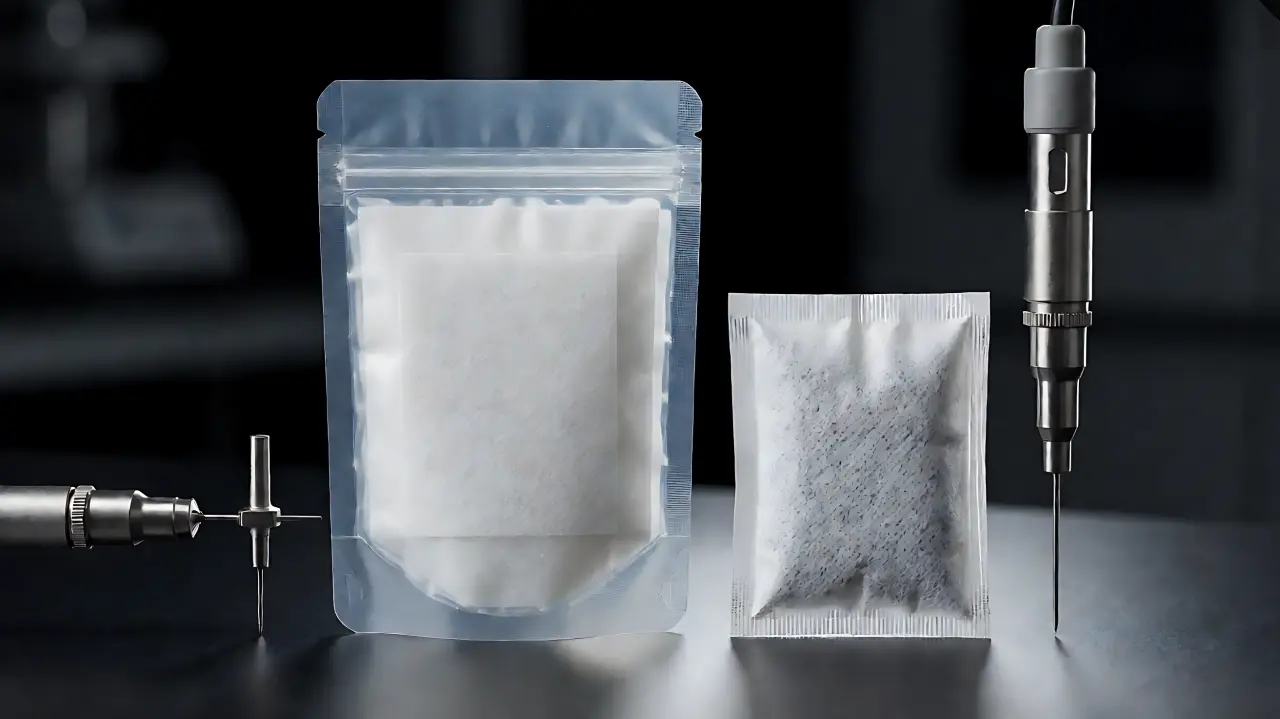
Active Oxygen Scavenging Polymers vs Sachets: Shelf-Life Guide
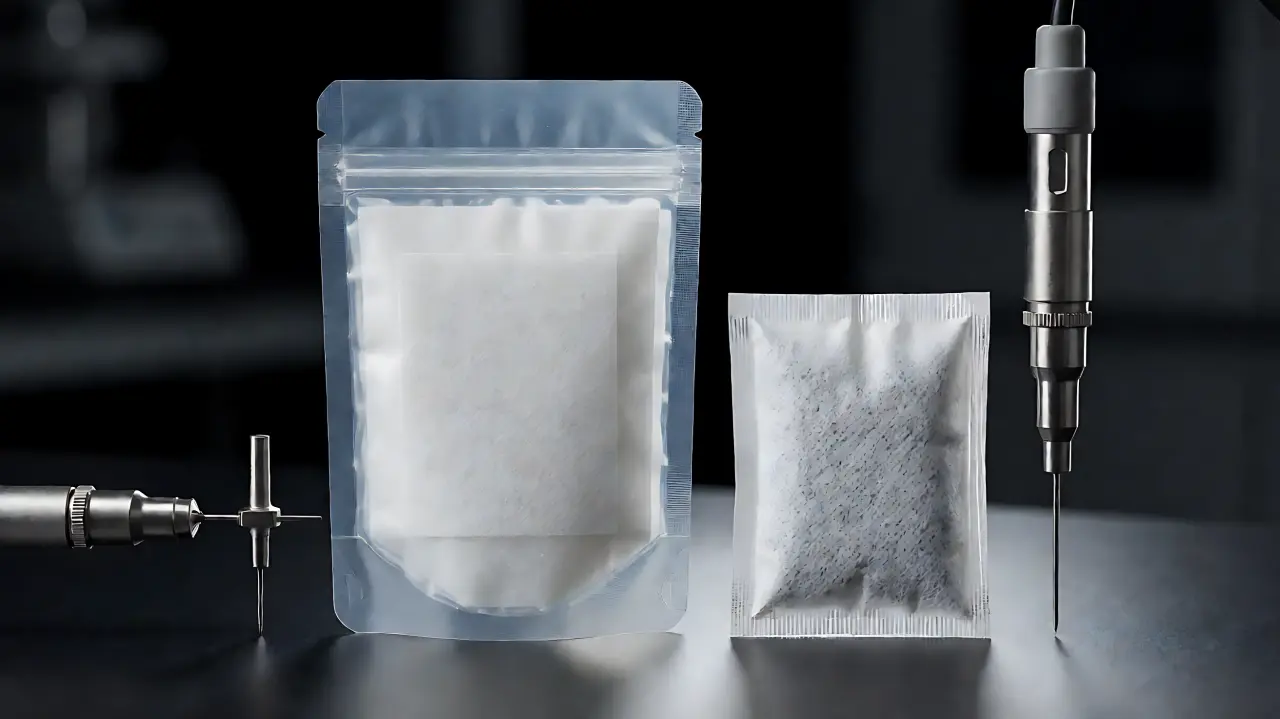
In extended shelf-life packaging for roasted nuts, infant nutrition, cured meats, and active pharmaceutical ingredients, passive high-barrier films (such as EVOH, PVDC, and aluminum foil) only retard oxygen ingress from the outside environment. They cannot eliminate residual oxygen trapped in the package headspace or dissolved within the product matrix at the moment of sealing.
To drive internal oxygen concentrations down to ultra-low levels ($< 0.1% \text{ to } < 10\text{ ppm}$), packaging engineers must choose between inserting Free Oxygen Absorber Sachets and coextruding Active Oxygen-Scavenging Polymers (AOS) directly into the film structure.
Chemical Mechanisms & Reaction Kinetics
Ferrous Iron Sachet (Moisture Activated)    Polymer Matrix Masterbatch (Embedded)
┌───────────────────────────────────────┐   ┌───────────────────────────────────────┐
│ Microporous Tyvek / PP Sachet Outer   │   │ Outer Substrate (PET / BOPA 12-15 µm) │
├───────────────────────────────────────┤   ├───────────────────────────────────────┤
│ Fe + O2 + H2O ──► Fe(OH)2 / Fe2O3     │   │ Gas Barrier Core (EVOH / AlOx 10-25 µm│
├───────────────────────────────────────┤   ├───────────────────────────────────────┤
│ Inserted loose into package pouch     │   │ Active Scavenger (MXD6 + Cobalt salt) │
└───────────────────────────────────────┘   ├───────────────────────────────────────┤
                 ▼                          │ Sealant Layer (mLLDPE / CPP 40-60 µm) │
   Requires moisture from food;             └───────────────────────────────────────┘
   Accidental consumer ingestion risk.                         ▼
                                             Continuous reaction throughout matrix;
                                             Invisible, tamper-proof, zero sachet!
1. Traditional Iron-Based Scavenger Sachets
Conventional oxygen scavenging relies on the oxidation of finely divided iron powder accelerated by sodium chloride catalysts:
$$4\text{Fe} + 3\text{O}_2 + 6\text{H}_2\text{O} \longrightarrow 4\text{Fe}(\text{OH})_3$$
- Moisture Dependency: The reaction requires free water vapor ($a_w > 0.50$) to proceed efficiently. In dry foods like powdered milk, crackers, or pharmaceuticals, iron sachets require pre-humidified carriers or react sluggishly.
- Accidental Ingestion Risk: Sachets pose ingestion hazards for children and pets, frequently trigger online consumer complaints, and may trip metal detectors on packaging lines.
2. Active Oxygen-Scavenging Polymers (AOS)
AOS masterbatches incorporate an oxidizable polymer phase dispersed into a polyolefin or polyamide carrier, catalyzed by trace transition metal carboxylates (typically cobalt neodecanoate, $50 - 200\text{ ppm}$):
- Oxidizable Substrates: Modified polybutadiene, hydrogenated polyisoprene, or aromatic polyamides like poly(m-xylylene adipamide) (MXD6).
- Free-Radical Auto-Oxidation: In the presence of cobalt catalyst, the oxidizable segments irreversibly bind oxygen molecules directly within the polymer backbone, converting them into benign hydroxyl and carboxylate groups without releasing volatile degradation by-products.
- Matrix Integration: The active material is coextruded as an internal tie-layer or blend within a 5- to 9-layer blown or cast film, completely separated from direct food contact by a certified polyolefin functional barrier layer (FDA 21 CFR § 177.1395).
Engineering Comparison: AOS Film vs. Sachet Insertion
| Technical Parameter | Iron-Based Sachet Insert | Active Oxygen Scavenging Polymer Film | Testing Method |
|---|---|---|---|
| Residual Headspace $O_2$ | Reducible to $< 0.1%$ ($1,000\text{ ppm}$) | Reducible to $< 0.001%$ ($10\text{ ppm}$) | MOCON Headspace Analyzer |
| Scavenging Capacity | $20 - 2,000\text{ cc } O_2\text{ / sachet}$ | $15 - 45\text{ cc } O_2\text{ / g polymer}$ | ASTM D3985 / Isothermal Test |
| Moisture Activation | Mandatory ($a_w \ge 0.55$) | Formulations available for $0%,\text{RH}$ | Controlled RH Chamber |
| Packaging Line Impact | Requires secondary sachet dispenser | Direct rollstock FFS runnability | Line OEE |
| Metal Detection | Requires specialized post-check | 100% Metal-detector transparent | Inline Sensitivity Test |
| Package Visuals | Loose foreign object inside pouch | Completely invisible to consumer | Sensory / Packshot |
| Material Cost | Low piece-part cost | Higher raw material resin premium | Total Cost of Ownership |
Arrhenius Temperature Dependency & Capacity Modeling
The rate of oxygen consumption in an active barrier pouch follows Arrhenius chemical kinetics:
$$k(T) = A \cdot \exp\left(-\frac{E_a}{R \cdot T}\right)$$
Where:
- $k(T)$: Oxygen uptake reaction rate constant.
- $E_a$: Activation energy of the catalytic oxidation reaction ($\approx 45 - 65\text{ kJ/mol}$).
- $R$: Universal gas constant ($8.314\text{ J}/(\text{mol}\cdot\text{K})$).
- $T$: Absolute temperature in Kelvin.
In refrigerated or cold-chain logistics ($4^\circ\text{C}$), iron sachet kinetics slow dramatically, often taking 48 to 72 hours to scavenge ambient oxygen. In contrast, specialized low-temperature AOS polymer formulations maintain rapid radical scavenging down to freezing temperatures, protecting lipid-rich foods against early hexanal formation and rancidity.
For related insights on food degradation prevention, read our guide on preventing fat oxidation in pet food packaging and explore stand-up barrier pouches.
Selection Guidelines for High-Value Goods
- Deploy Active Scavenging Polymers: In premium infant formula, pharmaceutical blister packs, high-end skincare, and export-grade roasted coffee beans where foreign sachets degrade consumer trust or risk choking hazards.
- Retain Iron Sachets: In cost-sensitive, high-headspace bakery items (such as mooncakes, pita pockets, and dried beef jerky) where high initial air volumes ($> 150\text{ cc } O_2$) require massive chemical absorption capacity at the lowest possible cost.
Contact CraftPack Global to engineer multi-layer active barrier laminates compatible with your existing flexible packaging formats.