
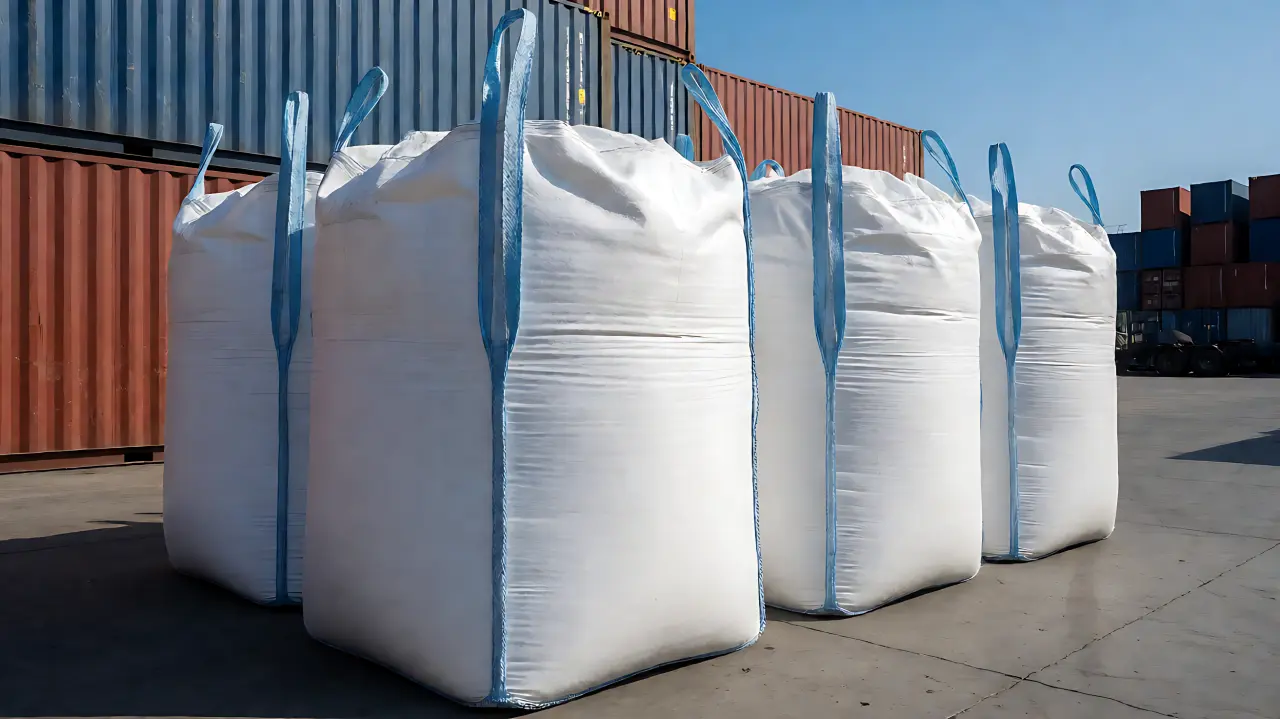
UV Stabilizers in FIBC Bulk Bags: ASTM G154 Weathering Guide
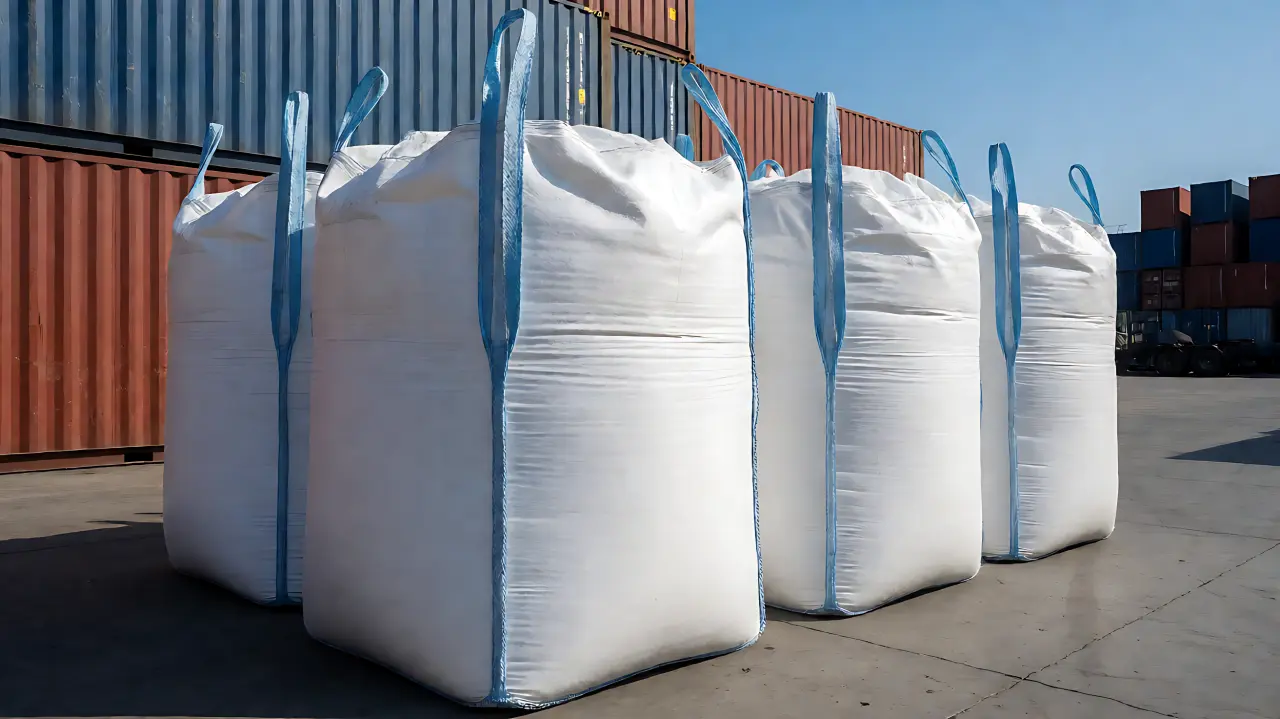
Flexible Intermediate Bulk Containers (FIBC), commonly known as big bags or jumbo sacks, are the primary bulk packaging format for dry chemicals, fertilizers, minerals, and agricultural grains. Carrying safe working loads (SWL) between $1,000\text{ kg and } 2,500\text{ kg}$, these heavy-duty woven polypropylene (PP) sacks are frequently stored outdoors in open shipyards, mining depots, and construction sites for months.
Polypropylene possesses an inherent tertiary carbon atom in every repeating unit, making it exceptionally vulnerable to solar ultraviolet (UV) photo-oxidation. Unstabilized PP fabric degrades within 6 to 12 weeks of direct sunlight exposure, resulting in micro-cracking, yarn powdering, and catastrophic lifting loop failures during crane handling.
To ensure occupational safety, bulk bag converters incorporate specialized Hindered Amine Light Stabilizers (HALS) validated under ASTM G154 and ISO 21898.
Photochemical Degradation: Free-Radical Auto-Oxidation
Solar ultraviolet radiation in the UVA ($315 - 400\text{ nm}$) and UVB ($280 - 315\text{ nm}$) spectrum provides sufficient photon energy to cleave carbon-hydrogen ($C-H$) bonds on the polypropylene backbone ($E_{\text{bond}} \approx 380\text{ kJ/mol}$):
Polypropylene Photo-Oxidation Cycle & HALS Radical Scavenging
            Solar UV Radiation (hν)
                      │
                      ▼
   Polymer Chain (R-H) ──► Free Polymer Radical (R•) + H•
                               │
               ┌───────────────┴───────────────┐
               ▼ + O2                          ▼
      Peroxy Radical (ROO•)           HALS Masterbatch (Denisov Cycle)
               │                               │
               ▼ + R-H                         ▼
      Hydroperoxide (ROOH) ──► Cleaves Nitroxyl Radical (>N-O•) Traps
      Chain Scission & Embrittlement!  Free Radicals Indefinitely!
Without chemical stabilization, chain scission lowers the molecular weight of the polypropylene tapes, causing tensile elongation at break to collapse from $> 20%$ down to $< 3%$, turning flexible yarns into brittle dust.
HALS Chemistry & The Denisov Regenerative Cycle
Unlike conventional UV absorbers (such as benzophenones) that merely absorb and dissipate UV photons, Hindered Amine Light Stabilizers (HALS) act as catalytic radical scavengers:
-
Oxidation to Nitroxyl Radicals: HALS compounds are converted into persistent nitroxyl radicals ($>N-O^\bullet$).
-
Scavenging Alkyl Radicals: The nitroxyl radical traps reactive polymer radicals:
$$>N-O^\bullet + R^\bullet \longrightarrow >N-O-R$$
-
Catalytic Regeneration (The Denisov Cycle): The resulting alkoxyamine reacts with incoming peroxy radicals ($ROO^\bullet$) to regenerate the active nitroxyl radical:
$$>N-O-R + ROO^\bullet \longrightarrow >N-O^\bullet + \text{Inert Products}$$
Because the active stabilizer radical regenerates repeatedly, a modest dosing of high-molecular-weight polymeric HALS ($0.2% \text{ to } 0.5%$ by weight) delivers multi-year outdoor photo-protection without rapid consumption.
ASTM G154 Accelerated Weathering Testing
Under ISO 21898 (Standard for Non-Dangerous Goods FIBCs), bulk bag fabric and load-bearing lifting straps must pass stringent accelerated UV weathering tests:
ASTM G154 Cycle 1 Protocol:
┌──────────────────────────────────────┐
│ Phase 1: 8 Hours UVA-340 Radiation   │ ◄── Irradiance: 0.89 W/m² at 340 nm;
│          Black Panel Temp: 60°C      │     Simulates peak solar UV spectrum.
├──────────────────────────────────────┤
│ Phase 2: 4 Hours Condensation        │ ◄── Water vapor condensation cycle;
│          Darkness, Temp: 50°C        │     Simulates nighttime outdoor dew.
└──────────────────────────────────────┘
Total Test Duration: 200 Hours to 1,200 Hours continuous cycling!
Regulatory Acceptance Criteria:
After completing the specified weathering cycle, test specimens cut from the woven fabric and lifting straps are pulled to tensile fracture on a universal testing machine:
$$\text{Retained Tensile Strength} = \frac{\text{Tensile Force}{\text{Aged}}}{\text{Tensile Force}{\text{Virgin}}} \times 100% \ge 50.0%$$
Under ISO 21898, the breaking force of the weathered fabric must retain at least $50%$ of its original unexposed value. For heavy-duty mining and chemical applications, premium FIBCs are engineered to retain $> 70%$ tensile strength after 1,200 hours of continuous ASTM G154 exposure.
Technical Formulation Comparison
| Performance Factor | Standard Industrial FIBC (Low UV) | Export-Grade Mining FIBC (High UV) | Agro-Chemical Marine FIBC | Testing Method |
|---|---|---|---|---|
| HALS Additive Loading | $0.10% - 0.15%$ wt | $0.30% - 0.50%$ wt | $0.40% + \text{Nickel Quencher}$ | Spectrophotometry |
| ASTM G154 Exposure | $200\text{ Hours}$ ($50%$ retained) | $600 - 800\text{ Hours}$ ($>60%$ retained) | $1,200\text{ Hours}$ ($>70%$ retained) | ASTM G154 / ISO 21898 |
| Outdoor Service Life | 3 - 6 Months (Moderate sun) | 12 - 18 Months (High UV tropics) | 24+ Months (Marine port storage) | Real-World Exposure |
| Safety Factor (SWL) | $5:1$ (Single-Trip) | $6:1$ (Standard Multi-Trip) | $8:1$ (Heavy-Duty Multi-Trip) | ISO 21898 Cyclic Rig |
| Sulfur / Acid Resistance | Poor (Pesticides deactivate HALS) | Moderate | Formulated with NOR-HALS | Chemical Compatibility |
Pesticide & Sulfur Deactivation Warning
In agricultural grain and sulfur mineral storage, acidic chemicals deactivate standard basic HALS molecules via salt formation. For bulk bags holding sulfur, organophosphate insecticides, or acidic fertilizers, converters must specify Non-Interacting HALS (NOR-HALS), whose low alkalinity prevents acid deactivation, preserving UV life.
Discover our heavy-duty BOPP woven bulk bags and reusable woven poly shopping totes. Contact CraftPack Global to engineer UV-stabilized FIBC bulk bags certified for extreme global weathering conditions.