
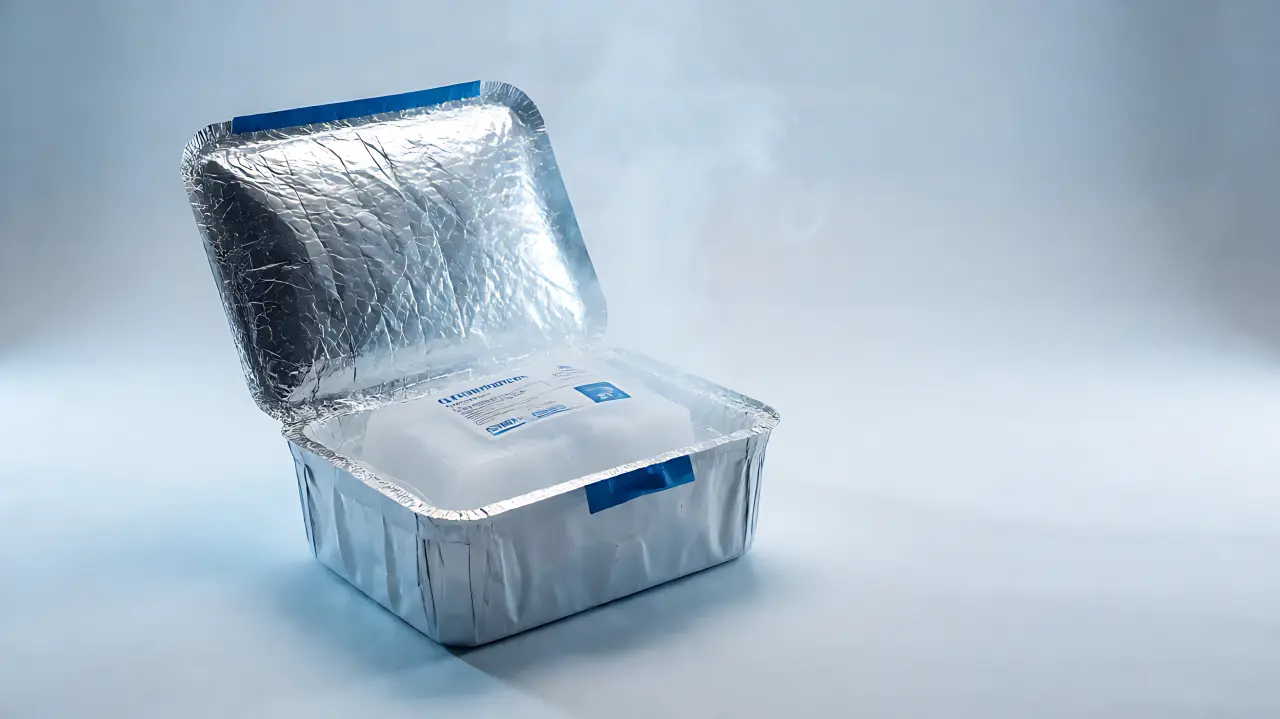
PCM Gel Packs vs. Dry Ice: Cold Chain Packaging Guide
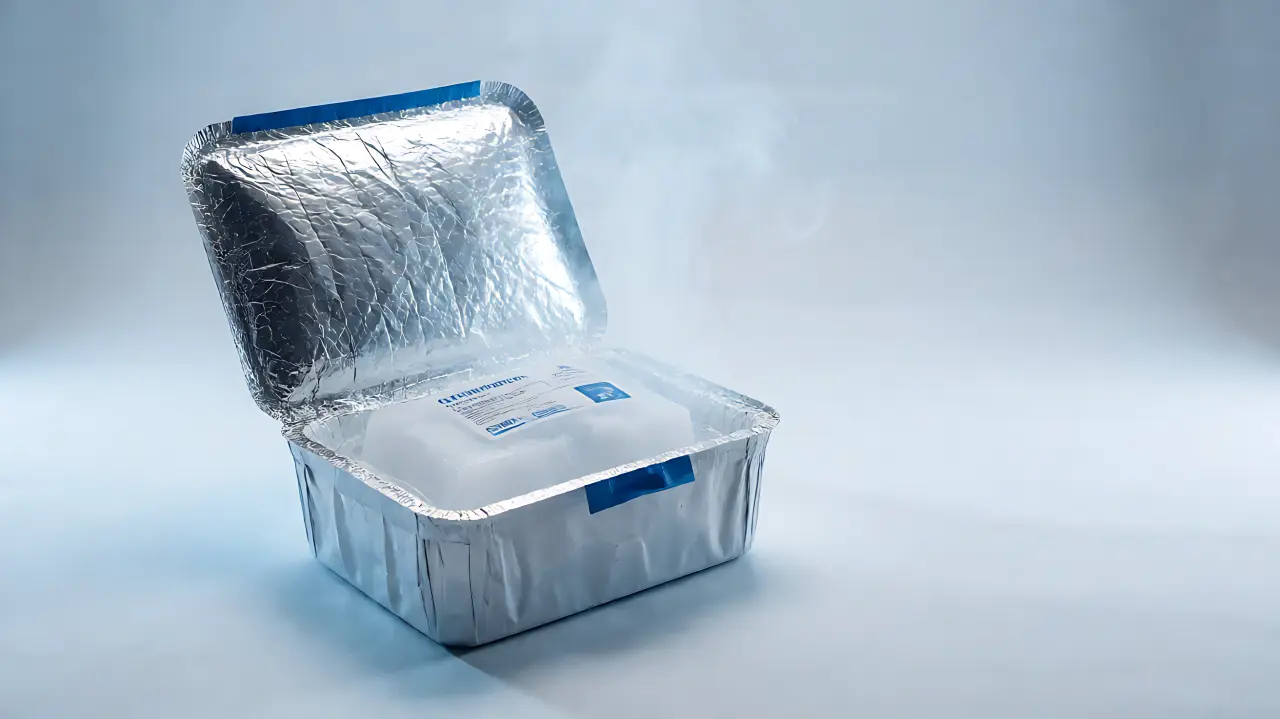
In temperature-controlled e-commerce logistics, direct-to-consumer (D2C) specialty foods, and clinical life-science biopharmaceuticals, maintaining strict payload thermal envelopes is essential. Whether shipping dry-aged steaks, temperature-sensitive vaccines, artisan gelatos, or active cellular therapies, cold chain packaging engineers must select the appropriate thermal refrigerant to counteract external summer heat waves.
The two primary refrigerant media deployed across global parcel networks are Phase Change Materials (PCM Gel Packs) and Solid Carbon Dioxide (Dry Ice).
However, selecting between PCM gel packs and dry ice involves fundamentally distinct thermal physics, hazardous material transport classifications (DOT Class 9 / IATA Dangerous Goods), sublimation gas pressure venting, payload freeze-damage risks, and lifecycle shipping economics.
This technical guide provides an engineering evaluation of PCM Gel Packs vs. Dry Ice, analyzing latent heat capacity, thermal transition plateaus ($0^\circ\text{C}$ vs. $-20^\circ\text{C}$ vs. $-78.5^\circ\text{C}$), hazardous freight compliance, and package gas-venting mechanics.
1. Technical Matrix: PCM Gel Packs vs. Solid Dry Ice
| Thermodynamic Metric | Engineered PCM Gel Packs (Water / Salt) | Organic Alkane PCM Gel Packs | Solid Carbon Dioxide (Dry Ice Blocks/Pellets) | Traditional Wet Ice (Legacy) |
|---|---|---|---|---|
| Physical Phase Transition | Solid to Liquid Melting (Fusion) | Solid to Liquid Melting (Fusion) | Solid to Gas Sublimation (No liquid phase) | Solid to Liquid Melting |
| Phase Transition Temperature | $0^\circ\text{C}$ (Standard) / $-16^\circ\text{C}$ (Eutectic) | $-21^\circ\text{C}$ to $+4^\circ\text{C}$ (Tunable) | $-78.5^\circ\text{C} \ (-109.3^\circ\text{F})$ (Extreme Deep) | $0^\circ\text{C}$ (Messy melt water) |
| Latent Heat of Transition | $334\text{ kJ/kg}$ (High heat absorption) | $180\text{ to }240\text{ kJ/kg}$ | $571\text{ kJ/kg}$ (Exceptional thermal sink) | $334\text{ kJ/kg}$ |
| Target Thermal Envelope | Refrigerated ($+2^\circ\text{C}\text{ to }+8^\circ\text{C}$) | Frozen ($-15^\circ\text{C}\text{ to }-25^\circ\text{C}$) | Deep Frozen ($< -20^\circ\text{C}\text{ to }-70^\circ\text{C}$) | Uncontrolled ($+2^\circ\text{C}\text{ to }+15^\circ\text{C}$) |
| Freeze Damage Risk to Payload | Low (Maintains steady 0°C to +4°C buffer) | Low (If matched to product target) | Extreme (Freezes moist foods rock-solid) | Low |
| DOT / IATA Hazardous Goods | Non-Hazardous (Zero air freight limits) | Non-Hazardous | DOT Class 9 Hazardous (UN 1845 Air Label) | Non-Hazardous |
| Shipper Venting Requirement | Hermetic Sealing Permitted | Hermetic Sealing Permitted | Pressure-Relief Venting Mandatory | Leak-proof drainage required |
| Reusability & Circularity | Reusable by consumer (Refreeze 100×) | Reusable | Consumed completely (Sublimates into air) | Discarded |
| Cost per kg of Refrigerant | Baseline ($0.35 – $0.65 / kg) | 2.5× to 4.0× Baseline | 1.8× to 2.8× Baseline + HAZMAT Fees | $0.10 / kg |
To explore our complete lineup of cold chain insulated mailers and box liners, visit our E-commerce Mailers Category.
2. Thermodynamics: Latent Heat of Fusion vs. Sublimation
The core physics governing refrigerant lifespan is Latent Heat Capacity:
Thermal Phase Transition Energy Absorption:
Latent Heat of Dry Ice Sublimation:             Latent Heat of Water-Based PCM Melting:
571 kJ/kg Energy Absorbed                       334 kJ/kg Energy Absorbed
Solid CO2 (-78.5°C) ──► Gaseous CO2             Solid PCM Ice (0°C) ──► Liquid PCM Gel
┌──────────────────────────────────────┐        ┌──────────────────────────────────────┐
│  Absorbs 1.7× more heat energy       │        │  Absorbs 334 kJ per kilogram during  │
│  per kilogram than water ice.        │        │  isothermal melting at 0°C plateau.  │
│  Leaves zero liquid melt residue.     │        │  Viscous crosslinked polymer prevents│
│  Expands 845× into CO2 gas.          │        │  messy parcel leaks upon thawing.    │
└──────────────────────────────────────┘ └──────────────────────────────────────┘-
Solid Carbon Dioxide Sublimation ($571\text{ kJ/kg}$):
- Dry ice transitions directly from a solid block to gaseous carbon dioxide at $-78.5^\circ\text{C}$ at atmospheric pressure, absorbing $571\text{ kilojoules}$ of heat energy per kilogram.
- Because it leaves zero liquid residue, dry ice keeps frozen meat, seafood, and ice cream rock-hard without waterlogged sogginess.
- Volumetric Gas Expansion: As dry ice sublimates, $1\text{ kg}$ of solid dry ice generates roughly $540\text{ liters}$ of gaseous $CO_2$.
-
Phase Change Materials (PCM Gel Packs):
- Formulated with purified water blended with food-grade cross-linked sodium polyacrylate superabsorbent polymers and eutectic salts (to depress freezing points to $-16^\circ\text{C}$ or $-21^\circ\text{C}$).
- PCM packs absorb $334\text{ kJ/kg}$ along a flat, stable temperature plateau at $0^\circ\text{C}$, preventing the payload from dropping into negative temperatures.
- When thawed, the cross-linked gel locks free water molecules into a viscous matrix, preventing liquid from flooding the shipper carton if the pouch outer film is punctured.
3. Regulatory Compliance: IATA / DOT Class 9 HAZMAT Restrictions
A pivotal logistics factor dictating refrigerant selection is air freight carrier compliance:
Shipping Compliance Requirements:
PCM Gel Packs:                                  Dry Ice (UN 1845 Class 9 Hazardous):
┌──────────────────────────────────────┐        ┌──────────────────────────────────────┐
│  - No HAZMAT labeling required       │        │  - IATA Class 9 Miscellaneous Label  │
│  - Zero quantity limits per aircraft │        │  - Max 2.5 kg to 5.0 kg per parcel   │
│  - No special airline surcharges     │        │  - $15 to $35 HAZMAT airline fee     │
│  - Zero asphyxiation risk            │        │  - Pilot-in-command cargo notification
└──────────────────────────────────────┘ └──────────────────────────────────────┘- Dry Ice Airline Restrictions: Because sublimating $CO_2$ gas displaces ambient oxygen, leading to cargo hold asphyxiation risks, the International Air Transport Association (IATA) and US Department of Transportation (DOT) classify dry ice under UN 1845, Class 9 Miscellaneous Dangerous Goods. Shippers face strict net weight limits (typically max 2.5 kg to 5.0 kg per parcel on passenger aircraft) and carrier surcharges ranging from $15 to $35 per parcel, severely inflating direct-to-consumer shipping costs.
- Pressure-Relief Packaging Architecture: Shippers containing dry ice must never be hermetically sealed. If an airtight foil barrier mailer is sealed over dry ice, expanding $CO_2$ gas creates high pneumatic pressure, culminating in explosive parcel ruptures in cargo sorting facilities. Insulated mailers engineered for dry ice must incorporate gas-permeable labyrinth micro-vents.
4. The “Cold-Burn” Spoilage Trap in Fresh Food Logistics
In fresh food e-commerce, using dry ice for non-frozen items is a major defect cause:
- The Freeze-Damage Phenomenon: Fresh produce, artisan cheeses, chilled salads, and unfrozen meats suffer irreversible structural damage when exposed to temperatures below $-2^\circ\text{C}$.
- Cellular Rupture: When placed near $-78.5^\circ\text{C}$ dry ice, intracellular water inside fresh foods freezes into jagged needle-like ice crystals, puncturing cell membranes. When the customer unpacks the parcel, leafy greens turn into blackened, liquefied sludge, and premium beef loses its natural myoglobin juices through massive liquid purge.
- The PCM Solution: Engineered $+4^\circ\text{C}$ or $0^\circ\text{C}$ PCM gel packs absorb heat while acting as a thermal floor: they ensure the payload never freezes, keeping food safely in the $+2^\circ\text{C}\text{ to }+6^\circ\text{C}$ chill zone.
5. Cold Chain Refrigerant Decision Framework
                      What is your product's required temperature profile?
                                     │
                     ┌───────────────┴───────────────┐
          Frozen or Deep Freeze (< -18°C)             Chilled / Ambient (+2°C to +8°C)
             (Ice Cream, Frozen Meat, Biopharma)          (Cheeses, Chocolate, Fresh Meals)
                     │                               │
        Does the shipment travel via air express Does product suffer cell damage / purge
         where dry ice HAZMAT surcharges apply?   if accidentally frozen below 0°C?
                     │                               │
        ┌────────────┴────────────┐             ┌────┴──────────────────────────┐
       YES                        NO            │ Deploy 0°C / +4°C PCM Gels:   │
        │                          │            │ - Artisanal cheese & dairy    │
  Deploy Eutectic -21°C PCM Gels:  │            │ - Premium confections         │
  - Zero HAZMAT air surcharges     │            │ - Fresh prepared meal kits    │
  - Non-hazardous classification   │            │ - Biologics & vaccines        │
  - Reusable by end consumer       │            └───────────────────────────────┘
                                   │
  Deploy Solid Dry Ice (Pellets):  │
  - Unmatched 571 kJ/kg heat sink  │
  - Zero liquid melt residue       │
  - Hard freeze preserved 48h+     └──────────> Pair with Insulated Foil Mailers
  - Mandatory pressure vents                    and Recycled Cotton Liners
To configure custom insulated thermal mailers, moisture-resistant shipping sleeves, and cold-chain parcel packaging engineered for your transit routes, connect with our logistics team via our E-commerce Mailers Packaging Group.